You bought a machine that looks the part, and the coffee still tastes thin, sour or burnt. The problem is rarely the machine on its own. It is the assumption that the machine is the whole system.
An espresso machine does two jobs: it heats water to a controlled temperature and pushes it through the coffee at pressure. Everything else — flavour, body, crema — is decided by the puck of ground coffee and how evenly water can travel through it. The machine sets the stage; the grinder writes the script. Spend ninety percent of the budget on a handsome machine and pair it with pre-ground coffee or a cheap blade chopper, and the water takes the easy path, drills a single channel through the bed, and leaves a shot that tastes sour and bitter in the same sip.
This guide treats the machine and the grinder as one decision rather than two. It maps the four architectures you can actually buy, walks through every machine and every grinder worth knowing at each budget, and pairs the specifications that matter with what these machines are really like after months of use. If you are still assembling the workspace around the machine, the companion guides on how to build an espresso setup and how to build a home coffee bar cover the workflow and the layout.
⚡Quick Comparison MatrixClick to ExpandAt a Glance: Home Espresso Machines and Grinder Pairings
Expand TableCollapse Table
At a Glance: Home Espresso Machines and Grinder Pairings
| Setup / Machine | Architecture | Regional Models & Pricing Snapshot | Grinder Pairing Strategy | Best For |
|---|---|---|---|---|
| Breville Barista Express (BES870) | All-in-one semi-automatic | US: approx. $499.95 · UK: approx. £499.00 · DE/FR/IT/ES: approx. €529.00 | Integrated conical burr with a stepped dial | Beans-to-espresso in under a minute with the full ritual kept on one footprint |
| De'Longhi Dedica Style (EC685) | Ultra-slim standalone semi-automatic | US: approx. $149.95 · UK: approx. £149.00 · DE: approx. €123.99 · FR/IT/ES: approx. €139.00 | External burr grinder, or a pressurized basket to start | Kitchens with only about 15 cm of clear worktop, renters and budget-aware beginners |
| Philips 2200 Series Panarello | Bean-to-cup fully automatic | US: approx. $349.00 · UK: approx. £279.00 · DE: approx. €239.00 · FR/IT/ES: approx. €259.00 | Built-in ceramic burr with hands-off internal dosing | Households that want one-touch coffee with no tamping, dosing or cleanup judgement |
| De'Longhi La Specialista Arte | Semi-automatic with a tamping station | US: approx. $699.95 · UK: approx. £399.00 · DE/FR/IT/ES: approx. €449.00 | Integrated sensor burr plus lever tamping | Drinkers who want semi-automatic flavour without loose grounds or uneven tamping |
| Casabrews CM5418 / Cecotec Power Espresso 20 | Compact budget semi-automatic | US: approx. $118.99 · UK: approx. £79.99 · DE/FR/IT/ES: approx. €59.90 | External grinder, or pressurized basket only | A low-risk first machine for milk-forward drinks while learning the routine |
| Blade grinders (Bosch TSM6A013B / Shardor) | Propeller blade chopper | US: approx. $25.99 · UK: approx. £23.99 · DE: approx. €19.99 · FR/IT/ES: approx. €19.99 | Not capable of espresso micro-adjustment; pressurized baskets only | Drip, French press and spice grinding, never a single-wall espresso basket |
Prices & availability subject to change. Affiliate links may earn a commission at no extra cost to you.
1. The Four Espresso Machine Architectures
Almost every home machine falls into one of four architectures. The architecture, not the badge on the front panel, decides what your routine feels like before you have pulled a single shot.
Architecture A — All-in-One Semi-Automatic With a Built-In Grinder
The grinder sits on top, drops fresh grounds straight into the portafilter cradle, and the machine handles temperature and pressure underneath. The appeal is self-contained: one plug, one footprint of roughly 32 to 35 cm, and a routine that runs from beans to espresso without moving anything across the kitchen. The trade-off is baked in — the built-in grinder usually adjusts in visible steps, the hopper sits above a warm chassis, and the grinder is wired into the machine, so a jam or a worn burr means the whole unit goes in for service.
Architecture B — Ultra-Slim Standalone Semi-Automatic
See the ultra-slim standalone machines →
A standalone semi-automatic does no grinding at all. It heats water fast through a thermoblock, and its only physical talent is a genuinely narrow body — in the case of the reference model, about 15 cm. That width is the entire pitch: it slips into the gap between the toaster and the sink where nothing else fits. Because there is no grinder onboard, this architecture is honest about what it needs: a separate burr grinder, a second power outlet and a little more worktop.
Architecture C — One-Touch Bean-to-Cup Fully Automatic
See the bean-to-cup machines →
A bean-to-cup machine takes the grinder, the dose, the tamp and the brew group and seals them inside a single cabinet. What it buys is speed and repeatability; what it costs is control. The grind and dose are managed internally, so there is no bottomless portafilter to diagnose channeling and no way to chase a specific extraction for a single-origin bean. The drink is consistent and hot rather than endlessly tunable.
Architecture D — Compact Budget Semi-Automatic
See the budget semi-automatics →
The fourth category is not a different mechanism but a different price point. These machines keep the manual portafilter and steam wand, strip out the automation, and often ship with a pressurized basket so that pre-ground coffee still produces a crema-topped shot. They are the cheapest honest way to learn the routine, provided you treat the pressurized basket as a starting point rather than a destination.
2. The Machine Lineup: Every Machine Worth Knowing
All-in-One Semi-Automatic: Grinder Built In
Breville Barista Express (BES870XL)
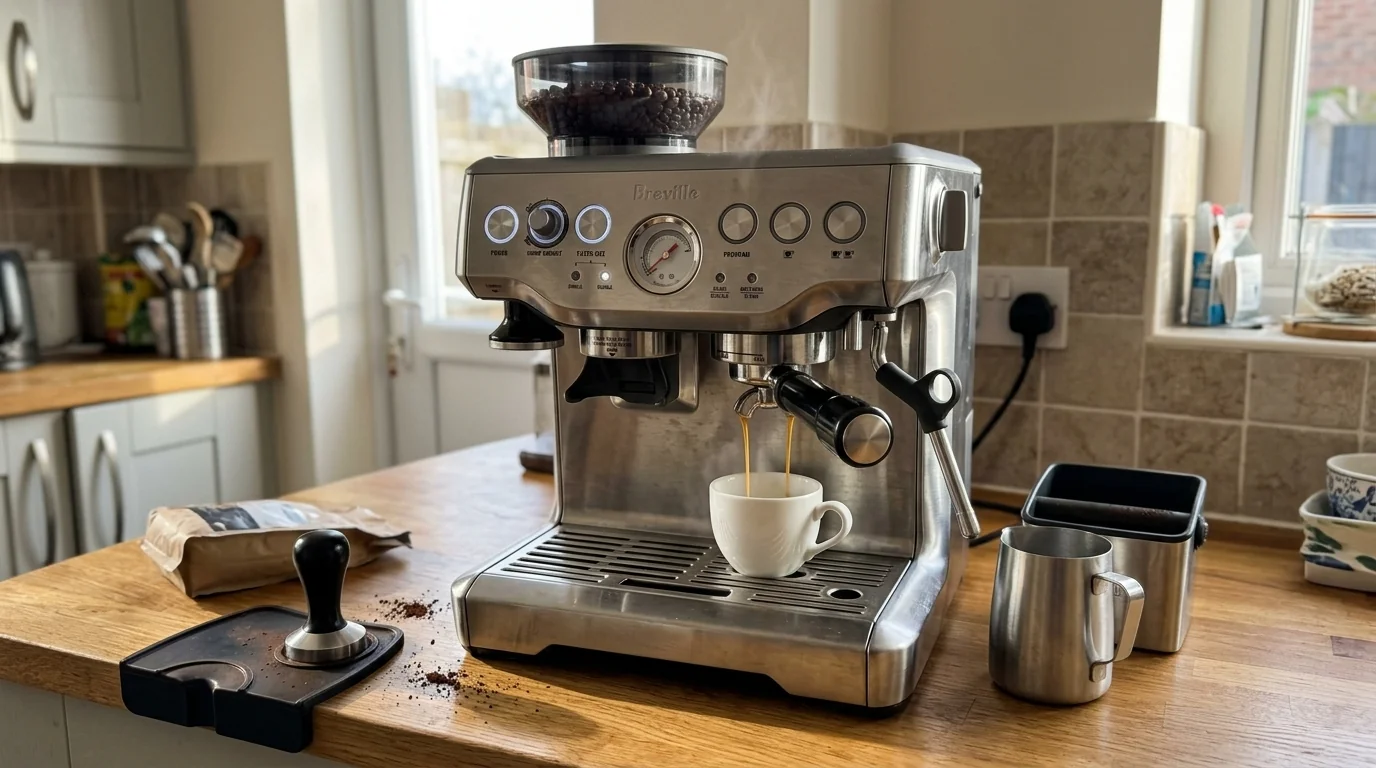
The Barista Express is the reference point for a first serious setup because it refuses to separate the two halves of the problem. Its integrated conical burr grinder doses on demand straight into the cradle, a digital PID holds the brew temperature steady, and low-pressure pre-infusion wets the puck gently before full pressure arrives. The portafilter is a 54 mm stainless unit with both single-wall and dual-wall baskets in one- and two-cup sizes, so you can begin on the forgiving dual-wall basket and graduate to a standard basket later. Power is 1600 W at 120 V, the bean hopper holds half a pound, and the water tank is a generous 67 ounces. The box is unusually complete: a razor dose-trimming tool, an integrated tamper, a stainless milk jug, a cleaning disc and tablets, a brush, an Allen key and a water filter with its holder.
The feeling it adds: A compact professional station where grinding, dosing and tamping happen in one uninterrupted gesture.
Key Design & Functional Highlights:
- Integrated grind-to-cradle workflow: the grind-size dial feeds the portafilter directly, keeping the counter clear and the dose fresh.
- PID temperature control with pre-infusion: water lands at a stable temperature and the puck is saturated evenly, the two levers that most affect shot consistency.
- Dual-purpose basket set: the dual-wall basket tolerates pre-ground coffee; the single-wall baskets reward a proper grinder.
Getting the Best From It:
- Start on the dual-wall baskets and graduate later: the machine ships with both basket types, so the first week stays forgiving while you find your grind, and the single-wall baskets reward the switch once the grinder is dialled in.
- Grind close to the moment you brew: topping the hopper up for a couple of days of drinks keeps the aroma bright, which is exactly what a built-in grinder is good at.
- Buy accessories sized for 54 mm: tampers and baskets made for this platform seat perfectly, and the shared Breville and Sage sizing means parts from either region fit.
Regional Model Comparison & Practical Notes: In North America the machine is sold as the Breville Barista Express on 120 V; the identical hardware is sold in the UK and EU as the Sage Barista Express on 230 V. The 54 mm portafilter is shared across both, so accessories bought for one fit the other — but the plug, voltage and warranty route differ, which matters if you move between regions.
Before adding it: Measure 32 to 35 cm of clear width, plus headroom for the bean hopper and rear clearance to lift out the 67-ounce tank. Check that your tallest cup fits under the spouts.
Shop this find:
- View on Amazon US
- View on Amazon UK
- View on Amazon DE
- View on Amazon FR
- View on Amazon IT
- View on Amazon ES
De'Longhi La Specialista Arte
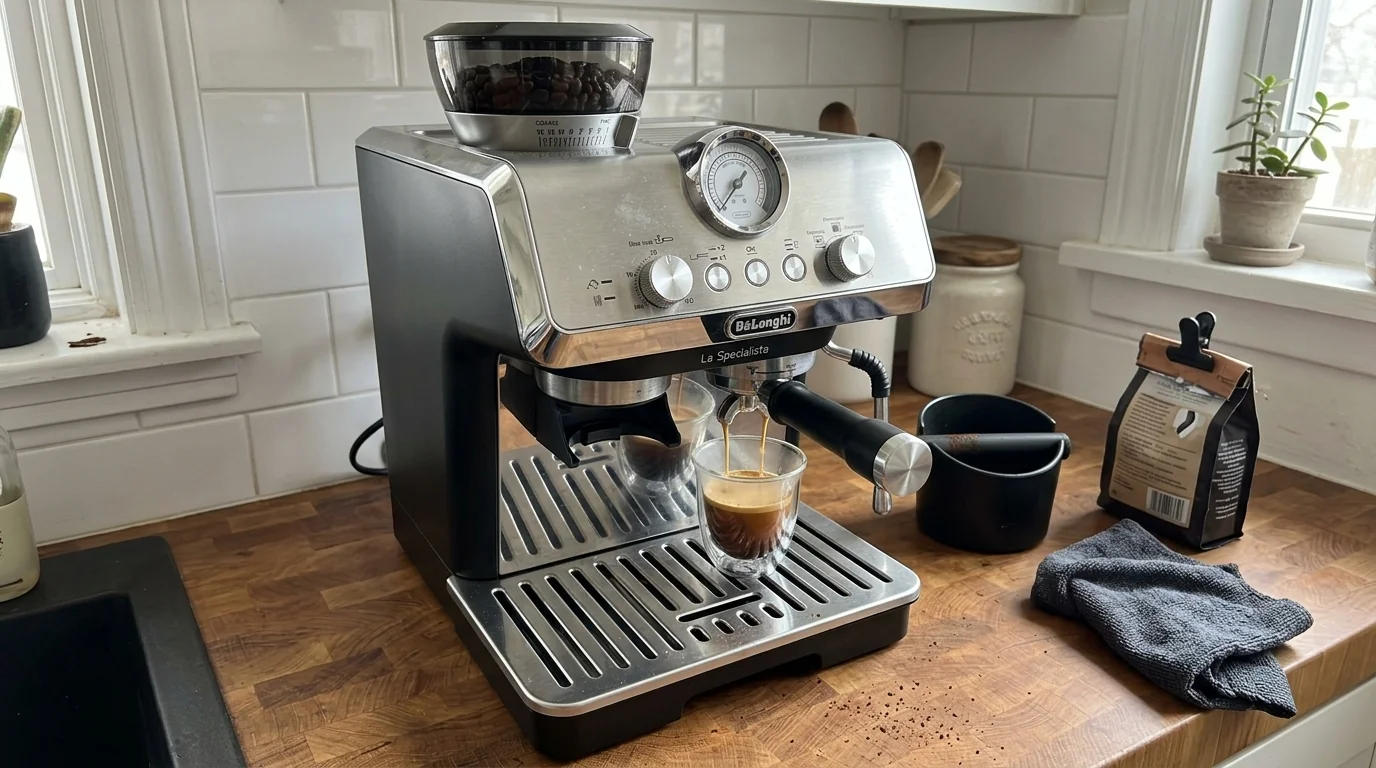
La Specialista Arte takes the same all-in-one idea and pushes the messy parts inside the machine. Its grinder uses two sensors to hold a consistent dose across different beans, a smart tamping station presses the puck with a lever at the correct pressure, and an active-temperature thermoblock keeps the brew water on profile. The milk system switches between FLAT for hot milk and FOAM for frothing, and three preset drinks cover the everyday routine. The result is a semi-automatic that behaves almost like a bean-to-cup at the two steps beginners find hardest — dosing and tamping — while keeping a real portafilter and steam wand for anyone who wants them.
The feeling it adds: The confidence of pulling a repeatable shot without a dusting of grounds across the countertop.
Key Design & Functional Highlights:
- Dual-sensor grinding: compensates for how different beans feed through the burrs, holding the dose steady as you change coffee.
- Lever tamping station: applies consistent pressure inside the machine, removing the tilted-puck error that ruins beginners' shots.
- Three presets plus a two-mode milk system: espresso, and milk drinks in either hot-milk or frothed form, with minimal input.
Getting the Best From It:
- The dosing path stays clean by design: grounds travel from the burr straight into the tamping station, and a quick brush after each session keeps it that way.
- Filtered water keeps the temperature profile and the descaling indicator steady, which is the single easiest habit for consistent shots in hard-water areas.
- The bundled tamper handles light use; if you tamp every morning, a solid metal tamper sized to the basket is a small upgrade that pays off in feel.
Regional Model Comparison & Practical Notes: The Arte is sold on 230 V in the UK and across the EU with a 230 V plug, and in North America in a 120 V version. The tamping station geometry and the sensor grinder are the same across markets; the differences are the plug, the voltage and the accompanying documentation.
Before adding it: Confirm the machine's height with the hopper fitted and check that the tamping-station lever has room to swing fully forward.
Shop this find:
- View on Amazon US
- View on Amazon UK
- View on Amazon DE
- View on Amazon FR
- View on Amazon IT
- View on Amazon ES
Ultra-Slim Standalone Semi-Automatic
De'Longhi Dedica Style (EC685)
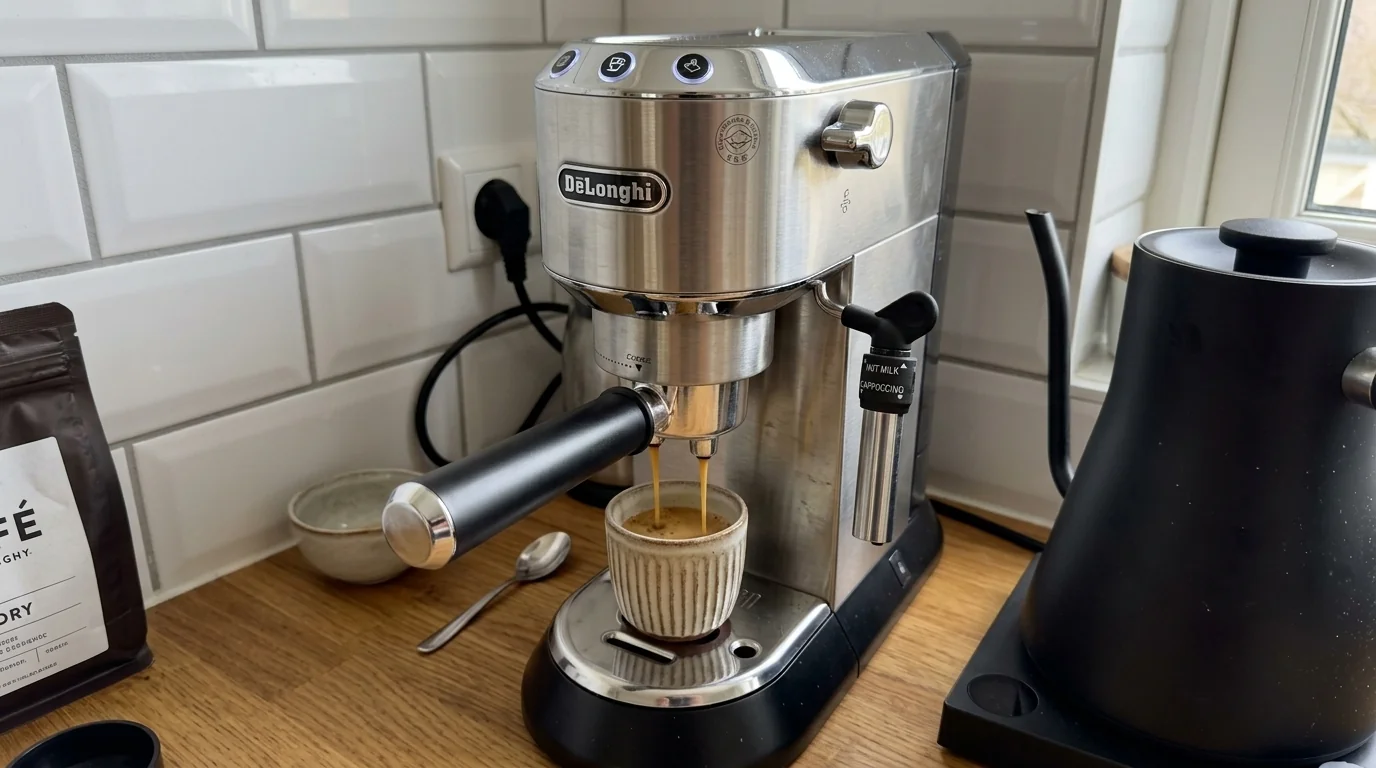
The Dedica Style is the machine that made 15 cm a selling point. Its thermoblock reaches brewing temperature in roughly 35 to 40 seconds, the 15 bar pump drives a compact but genuine espresso routine, and the adjustable cup shelf takes glasses up to about 12 cm. The portafilter holder accepts one- and two-cup baskets and is compatible with ESE single-dose pods, the steam nozzle is adjustable, and coffee volume, temperature and water hardness are all programmable. The body is stainless steel, the water tank is removable at around 1.1 litres, and power is roughly 1300 W. It is the smallest way to own a real portafilter machine without giving up a steam wand.
The feeling it adds: A slim, uncluttered espresso machine that earns its place in a kitchen that has no spare space to give.
Key Design & Functional Highlights:
- Fifteen-centimetre body: the single most space-efficient footprint among mainstream semi-automatics.
- Programmable dosing and temperature: three buttons and a dial that let you set the shot to your bean rather than accept a fixed recipe.
- Ground coffee and ESE pod compatibility: a flexible basket set for anyone who wants to switch between fresh grounds and pods.
Getting the Best From It:
- The steam wand is where the machine shines: a few sessions of practice with the wand angle and depth are all it takes to get glossy, creamy microfoam.
- Open with a short cooling flush: thirty seconds of flushed water settles the group head, and the first real shot lands noticeably sweeter.
- The tank is sized for a small kitchen: around five to six drinks per fill, with the level always visible, and two hands on the tank keep the counter dry.
- Lift the portafilter out after each session, so the basket sits free the next morning and the machine is always ready.
- Press the bundled tamper with your fingers braced behind the disc, or step up to a metal tamper for daily use.
Regional Model Comparison & Practical Notes: The German market sells the machine as the Dedica Style at around 123.99 €, while Spain sells the same hardware as the Dedica Style Perfetto (EC685) at around 139,00 €, with the variant adding a 360° rotating cappuccinatore. Both are 230 V with the appropriate national plug; the portafilter and baskets are shared.
Before adding it: Budget for a separate grinder and a second outlet. Confirm the cup shelf height against your tallest mug, and leave vertical clearance for the steam wand.
Shop this find:
- View on Amazon US
- View on Amazon UK
- View on Amazon DE
- View on Amazon FR
- View on Amazon IT
- View on Amazon ES
Bean-to-Cup Fully Automatic
Philips 2200 Series Panarello
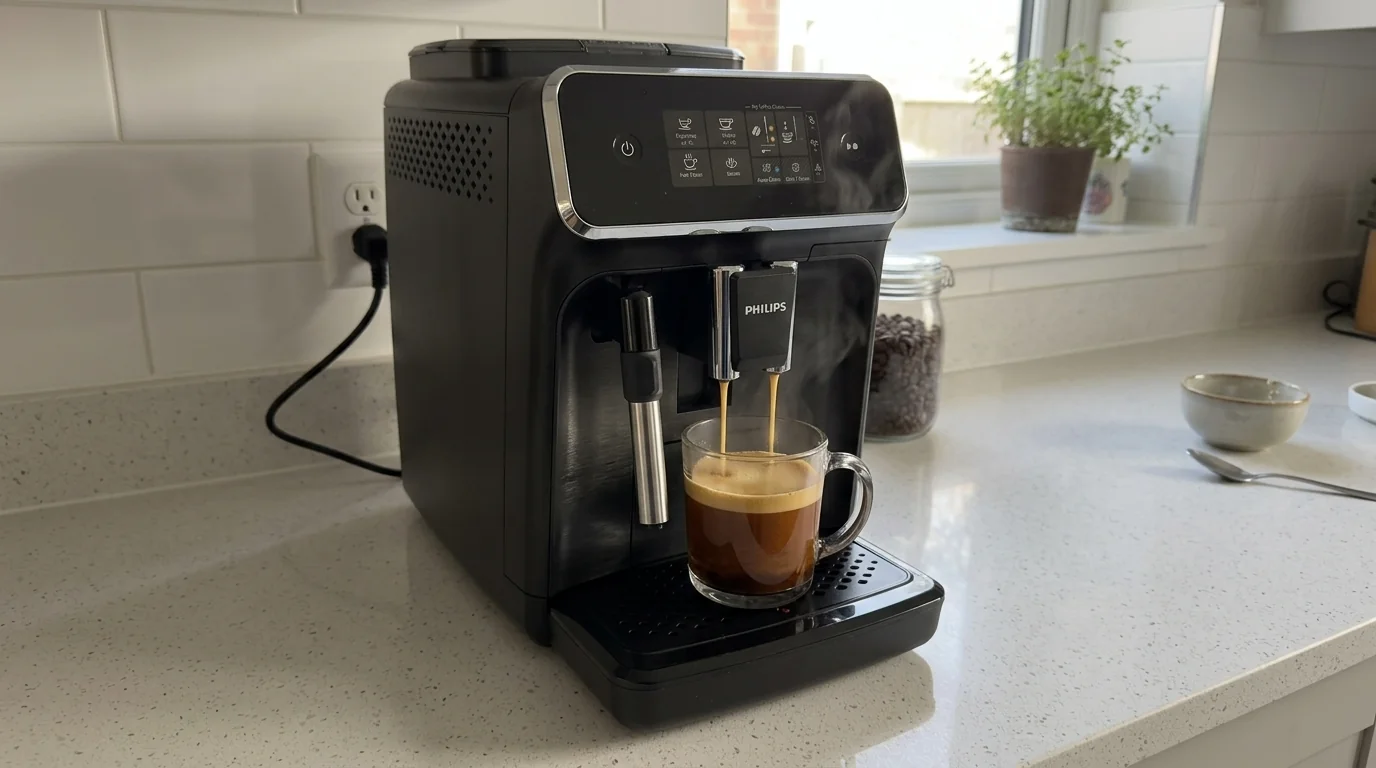
The 2200 Series is the archetype of the affordable bean-to-cup. Its ceramic grinder's output, coffee strength, volume and temperature are all adjustable, the classic Panarello frother comes apart into just two dishwasher-safe pieces, and an AquaClean filter is compatible with the water tank to stretch the interval between descaling jobs. The brew group lifts out and rinses under the tap, which is the hygienic heart of the design. It is one-touch: beans in, water in, a button pressed, a drink out.
The feeling it adds: A quiet, hands-off morning where the only decision is which button to press.
Key Design & Functional Highlights:
- Removable brew group: the core can be taken out and rinsed, which is the difference between a machine that stays clean and one that does not.
- AquaClean filter compatibility: reduces limescale and pushes descaling far into the future.
- Two-part dishwasher-safe frother: milk cleanup measured in seconds rather than minutes.
Getting the Best From It:
- Long-term reliability is the headline: these machines are known for running daily for two to five years on nothing more than routine care.
- The removable brew group is the best part of the design: lift it out, rinse it under the tap, and give it a weekly brush to keep it hygienic for years.
- The AquaClean filter pushes descaling far into the future: a small part that removes a large chore, and worth fitting from day one.
- Keep beans in the freezer and refill in small amounts: the built-in grinder is at its best with whole beans, and the cup improves when they are fresh.
- Set the machine going a minute before you need it: the one-touch cycle is quick, and the start-up rinse arrives at exactly the right moment to warm the cup.
Regional Model Comparison & Practical Notes: The same platform sells in Germany at around 239,00 € and in France at around 269,28 € in a matte-black finish. Both are 230 V; the AquaClean filter and frother parts are shared across the range.
Before adding it: Check the maximum cup volume against your favourite mug — the ceiling is lower than it looks — and confirm the machine will not sit directly under a cabinet given the hopper lid travel.
Shop this find:
- View on Amazon US
- View on Amazon UK
- View on Amazon DE
- View on Amazon FR
- View on Amazon IT
- View on Amazon ES
De'Longhi Magnifica S
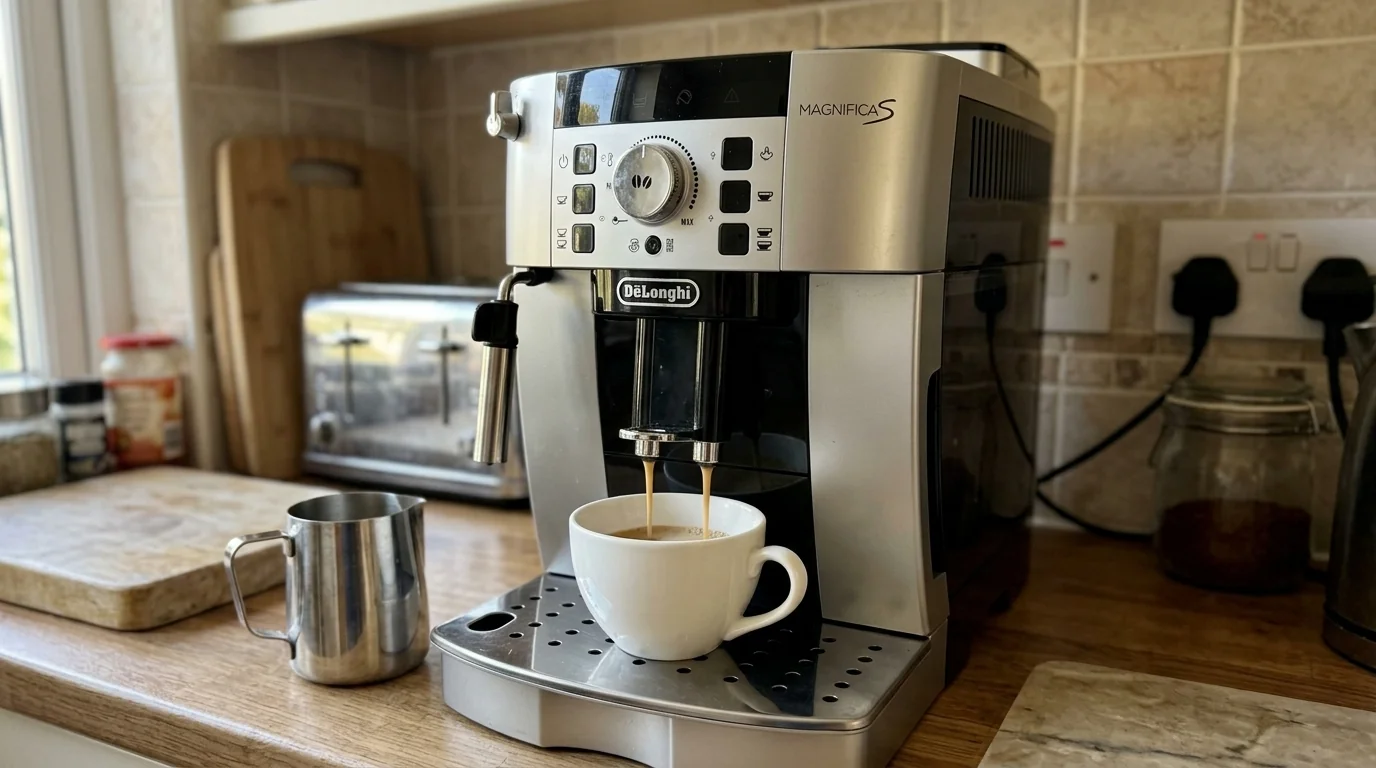
The Magnifica S is the compact counterpart to the Philips: a built-in grinder with thirteen settings, freshly ground coffee for every cup, one-touch short or long coffee, and a 2-in-1 manual frother that produces either hot milk or a dense foam for cappuccinos. The spout suits cups from 8 to 14 cm, and automatic rinse and descaling programs handle the maintenance that would otherwise be forgotten. It also adds auto shut-off, an energy-saving mode and standby.
The feeling it adds: A proper cappuccino from a machine that takes up less counter than a kettle and a toaster combined.
Key Design & Functional Highlights:
- Thirteen grind settings: enough range to move between a mellow blend and a punchier roast without changing machines.
- 2-in-1 manual frother: one spout that toggles between hot milk and dense foam.
- Automated rinse and descaling: the machine nudges you through the jobs that keep it alive.
Getting the Best From It:
- The flavour deepens over the first few weeks as the grind and dose settle in: the opening cups are the machine finding its feet, and the result afterwards is noticeably richer.
- Two minutes with the manual (or a short video) repays itself: the grind, strength and temperature settings work together, and dialling them in once is enough.
- Filtered water from the start keeps the brew path clean and makes the descaling routine rare.
- Plain, unflavoured beans keep the grinder running like new for years, since the oils that carry added aromas are the same ones that gum up the burrs.
Regional Model Comparison & Practical Notes: This is primarily a European 230 V machine, with the French market listing it at around 299,99 €. The grinder setting steps are conservative, which suits the machine's all-round role but limits very fine adjustments.
Before adding it: Plan for filtered water from the start, and leave clearance above the bean hopper for refilling.
Shop this find:
- View on Amazon US
- View on Amazon UK
- View on Amazon DE
- View on Amazon FR
- View on Amazon IT
- View on Amazon ES
Compact Budget Semi-Automatic
Casabrews CM5418
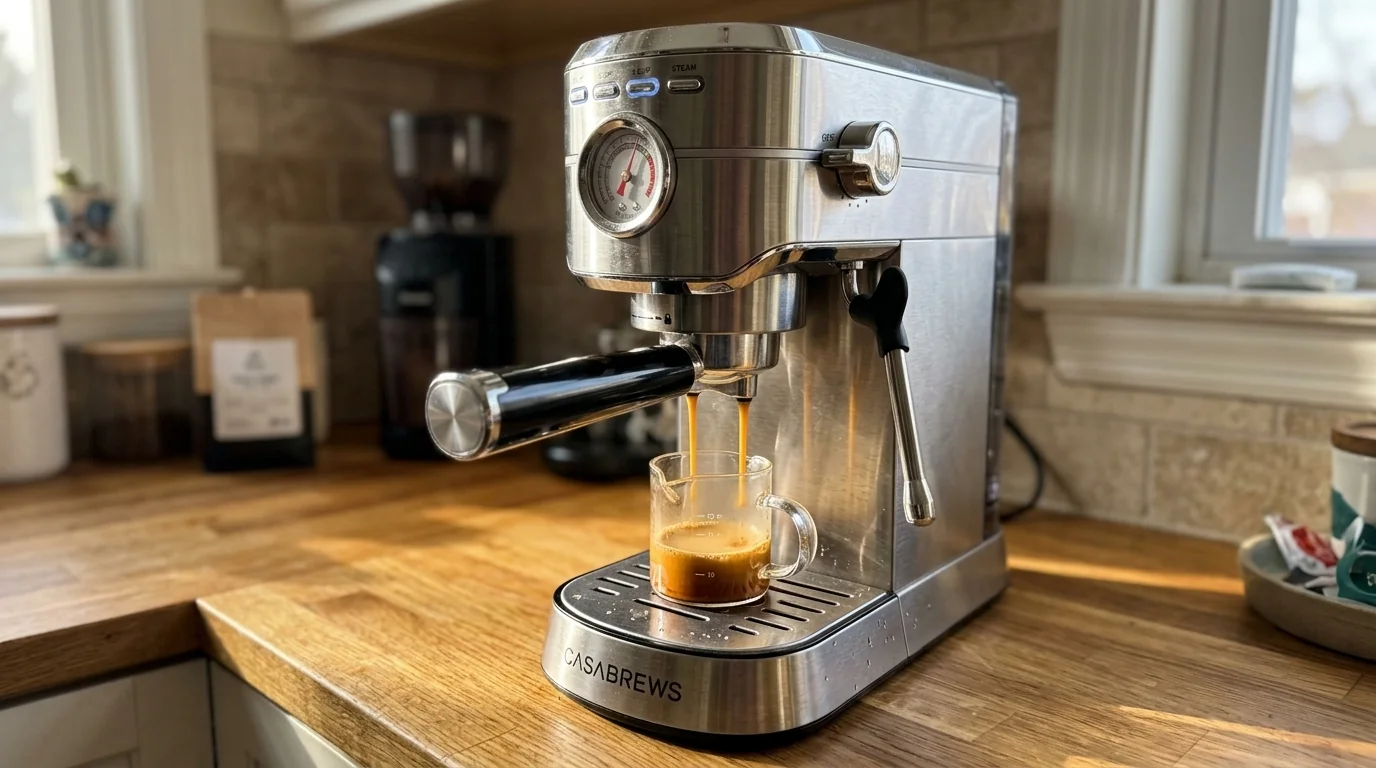
The CM5418 is the smallest serious semi-automatic on this list. A 20 bar Italian pump and a 1350 W boiler sit inside a stainless-look body, and a built-in pressure gauge lets you watch what the pump is doing — a rare feature at the price. The 34-ounce water tank detaches for filling, the box includes one- and two-cup baskets and a portafilter with a combination spoon-tamper, and the machine runs an overheat-protection mode that flashes the one- and two-cup lights after steaming milk.
Key Design & Functional Highlights:
- Onboard pressure gauge: the single most useful instrument for a beginner learning how grind affects flow.
- Compact stainless body: fits a small counter without the visual bulk of a full-sized machine.
- Removable water tank: refilling without moving the machine.
Getting the Best From It:
- The pressure gauge is the standout feature at this price: watching the needle teaches you how grind and dose change the shot faster than any guide.
- The compact stainless body earns its space on a small counter without the visual bulk of a full-size machine.
- After steaming, the lights guide a short cool-down: a moment's wait, then the next shot lands at the right temperature.
- Read the "20 bar" as a pump rating: the useful pressure at the puck is the classic espresso range, and the gauge is there to confirm it.
Before adding it: Pair it with a proper burr grinder. As a first machine it works best on the included baskets with a modest grinder, then improves sharply once you add a non-pressurized basket and fresh-ground coffee.
Shop this find:
- View on Amazon US
- View on Amazon UK
- View on Amazon DE
- View on Amazon FR
- View on Amazon IT
- View on Amazon ES
Quest 15 Bar Espresso Machine
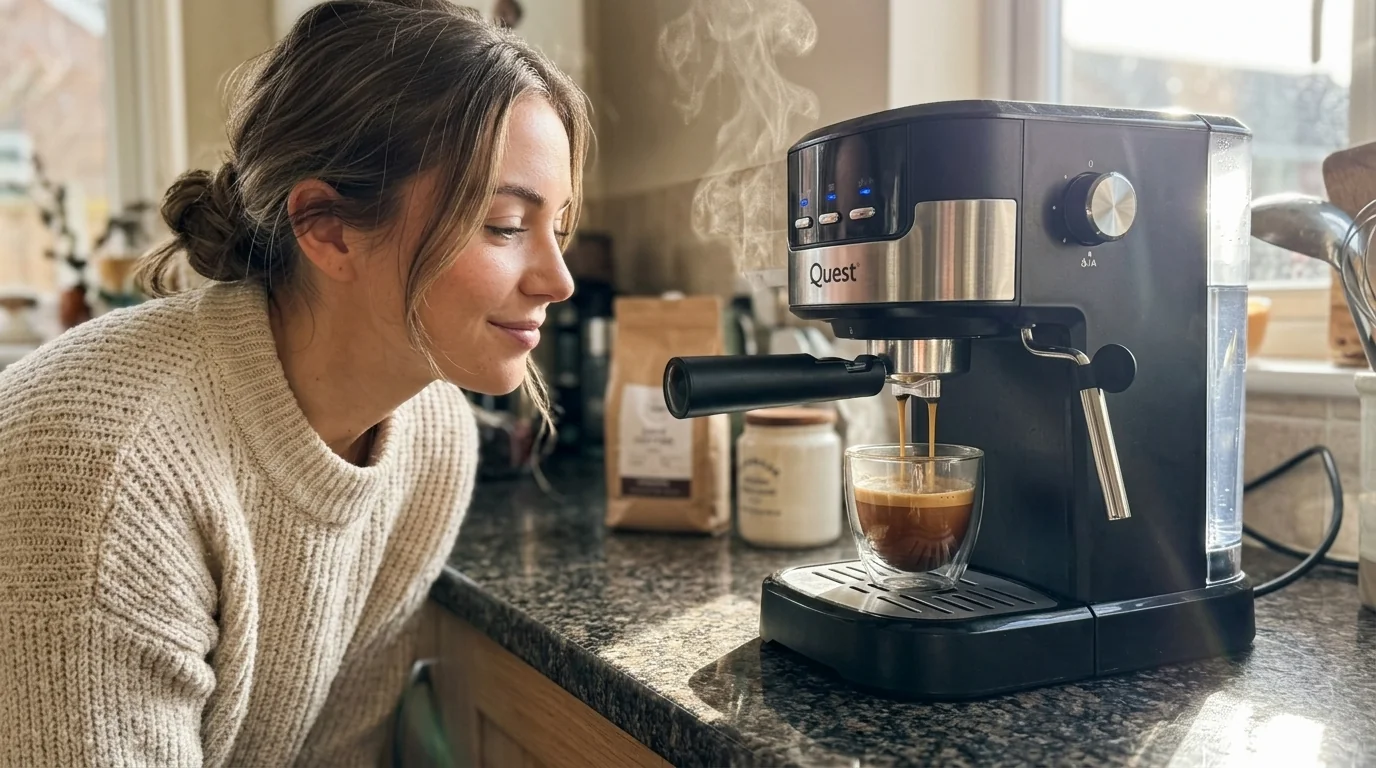
The Quest is the UK's budget entry: a 15 bar pump, a large 1.2-litre transparent removable tank, and a permanent stainless steel filter that removes the need for paper. Dual stainless filters sit in the portafilter, a removable drip tray makes cleanup quick, and the box includes a spoon-tamper and two measuring cups. It is a machine built around price and simplicity rather than specification.
Key Design & Functional Highlights:
- Permanent stainless filter: no recurring paper, and less waste.
- 1.2-litre transparent tank: enough for several drinks with a visible water level.
- Small learning curve: right for one or two cups with minimal cleaning.
Getting the Best From It:
- It steams up a thicker, creamier foam than a cafetière or a moka pot, so cappuccinos are genuinely on the menu at this price.
- The permanent stainless filter means no paper and no recurring cost: one rinse and it is ready for the next brew.
- The 1.2-litre transparent tank shows exactly how much water is left, so a second cup never runs flat.
- It is at its happiest making one or two fresh drinks rather than a full carafe, which is how most households use it.
Before adding it: Check the actual basket diameter against accessory sizes before buying a tamper or dosing funnel. At this price, plan on a standalone grinder rather than pre-ground coffee for the best results.
Shop this find:
- View on Amazon US
- View on Amazon UK
- View on Amazon DE
- View on Amazon FR
- View on Amazon IT
- View on Amazon ES
De'Longhi EC260.BK
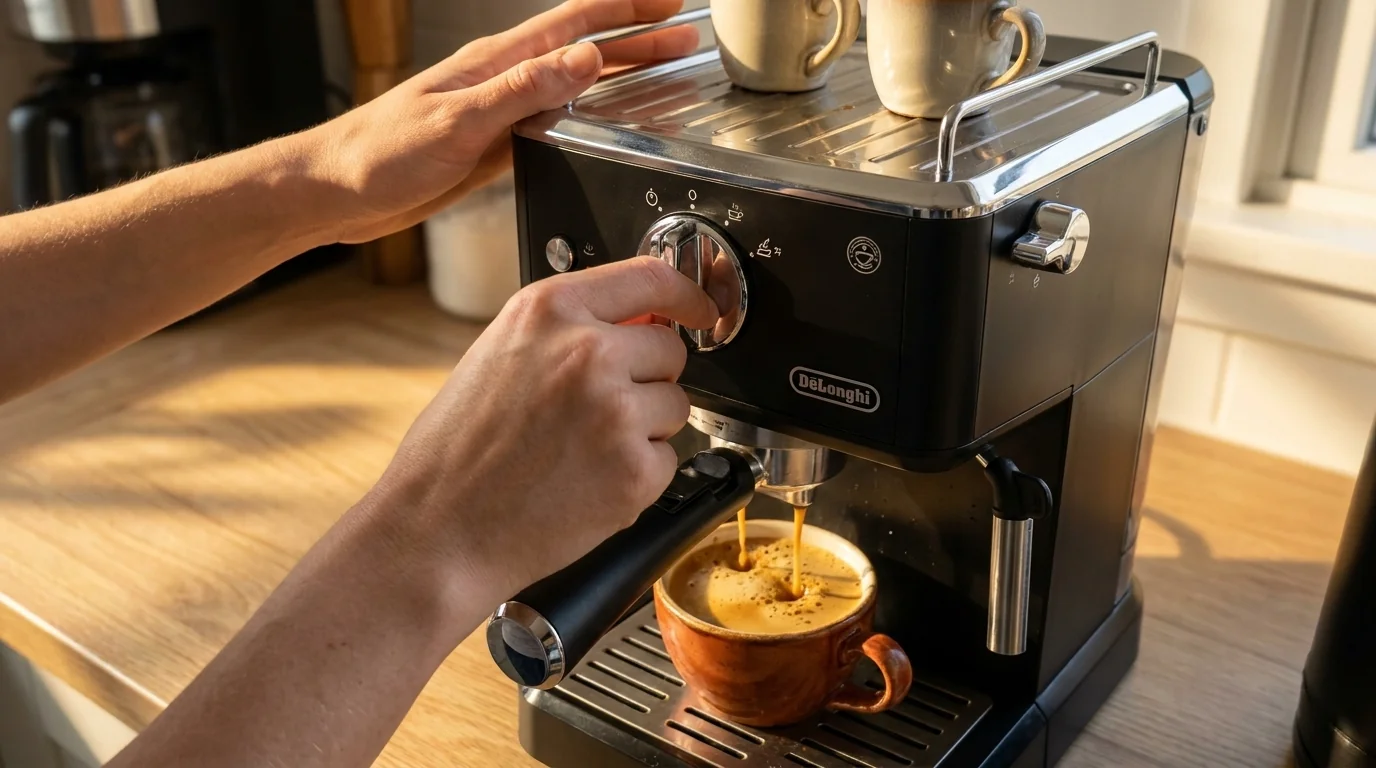
The EC260 is the Italian budget classic: a black body with a chrome stainless front panel, a manual milk system, and a single control knob that handles on/off, espresso and cappuccino. What lifts it above its price is the boiler — stainless steel rather than the aluminium found in many rivals — and a portafilter with a crema device that accepts both ground coffee and 44 mm ESE pods. The removable tank holds about 1.1 litres, the cup shelf is dishwasher-safe, and a warming plate tops the machine.
Key Design & Functional Highlights:
- Stainless steel boiler: more durable and more stable than the aluminium boilers common at this price.
- Ground coffee and ESE pod compatibility: the same portafilter handles both.
- Single-knob operation: the whole machine runs from one control, which is exactly what a beginner wants.
- Fifteen bar pump with a cup-warmer plate: a compact footprint with the small conveniences of larger machines.
Getting the Best From It:
- The stainless steel boiler is the headline: it holds temperature more stably and outlasts the aluminium boilers common at this price.
- One knob runs the whole machine — on/off, espresso, cappuccino — which makes the first week genuinely simple.
- Ground coffee and 44 mm ESE pods share the same portafilter, so you can keep pods for rushed mornings and grind when there is time.
- Rinse the basket out right after each shot, so it lifts out freely and the crema stays consistent.
- A non-pressurized portafilter is the classic upgrade if you want to explore freshly ground coffee further.
Regional Model Comparison & Practical Notes: Sold in Italy at around 99,90 € on 230 V with a European plug, and popular across southern Europe for its stainless boiler. The 44 mm ESE pod format is widely available in Italy but less so elsewhere, which affects how useful the pod mode is outside its home market.
Before adding it: Decide up front whether you will rely on ESE pods or fresh-ground coffee. If fresh-ground, budget for a burr grinder and a non-pressurized basket to unlock the machine's potential.
Shop this find:
- View on Amazon US
- View on Amazon UK
- View on Amazon DE
- View on Amazon FR
- View on Amazon IT
- View on Amazon ES
Cecotec Power Espresso 20
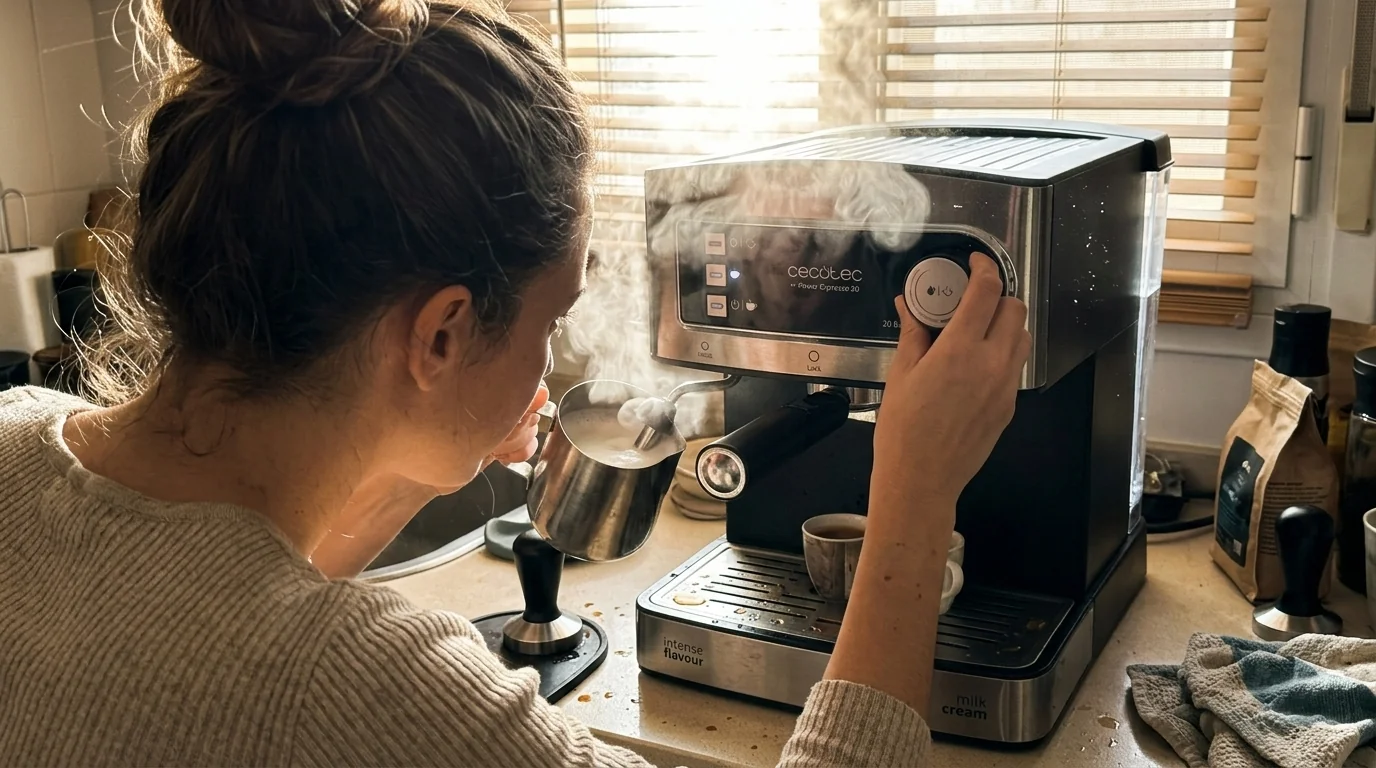
The Cecotec Power Espresso 20 is the value champion of the budget tier: 20 bar pressure and an 850 W boiler at a price that undercuts almost everything else here, plus a cup-warming surface, a dual-spout arm, two portafilters for one or two cups, an adjustable steam nozzle with a hot-water function, and per-function indicator lights. The removable tank holds 1.5 litres, the drip tray detaches, and a safety valve releases pressure automatically.
Key Design & Functional Highlights:
- Twenty bar pump and cup warmer at entry price: the two features that make the biggest visible difference in this bracket.
- Dual-spout arm and two baskets: genuinely brews two cups at once.
- Safety valve and removable drip tray: the maintenance basics are all present.
Getting the Best From It:
- The cup-warming surface and dual-spout arm bring café touches to a budget machine: two cups at once, both warm and crema-topped.
- Because you stop the shot yourself, you get exactly the ristretto or lungo you want rather than a preset.
- Begin with a short flush of hot water: it warms the group head, and the first cup lands at the right temperature.
- Rinse the steam nozzle straight after every use and it stays clean and odour-free.
- A rubber mat underneath keeps the machine planted and quiet on a hard counter.
- A non-pressurized basket is a rewarding first upgrade once you are grinding fresh beans.
Regional Model Comparison & Practical Notes: Sold in Italy and Spain at around 59,90 € on 230 V. The Italian listing carries a slightly lower average rating than the Spanish one, which reflects the wider pool of heavy daily users in Italy rather than a hardware difference between the two markets.
Before adding it: Accept that this is a learning machine. Budget for a burr grinder and a non-pressurized basket, and treat the steam wand as a part to rinse after every single use.
Shop this find:
- View on Amazon US
- View on Amazon UK
- View on Amazon DE
- View on Amazon FR
- View on Amazon IT
- View on Amazon ES
3. Machine Comparison: Key Specs Side by Side
| Model | Architecture | Key specifications |
|---|---|---|
| Breville Barista Express (BES870XL) | All-in-one semi-automatic | 1600 W · digital PID temperature control · low-pressure pre-infusion · integrated conical burr with a stepped dial · 54 mm portafilter · single- and dual-wall baskets · 1/2 lb hopper · 67 oz tank |
| De'Longhi La Specialista Arte | All-in-one semi-automatic | Dual-sensor grinder · lever tamping station · active-temperature thermoblock · 3 drink presets · FLAT and FOAM milk system |
| De'Longhi Dedica Style (EC685) | Ultra-slim standalone semi-automatic | 15 cm wide · thermoblock ready in 35–40 s · 15 bar · adjustable cup shelf to 12 cm · ground coffee and ESE pods · 1.1 L tank · programmable dose |
| Philips 2200 Series Panarello | Bean-to-cup fully automatic | Adjustable grind, strength, volume and temperature · ceramic grinder · two-part dishwasher-safe frother · AquaClean filter · removable brew group |
| De'Longhi Magnifica S | Bean-to-cup fully automatic | 13-step built-in grinder · one-touch short or long coffee · 2-in-1 manual frother · 8–14 cm cup clearance · automatic rinse and descaling |
| Casabrews CM5418 | Compact budget semi-automatic | 20 bar pump · 1350 W · built-in pressure gauge · 34 oz removable tank · 1- and 2-cup baskets · steam wand |
| Quest 15 Bar | Compact budget semi-automatic | 15 bar pump · 1.2 L transparent removable tank · permanent stainless filter · dual stainless filters · removable drip tray |
| De'Longhi EC260.BK | Compact budget semi-automatic | 15 bar · stainless steel boiler · ground coffee and 44 mm ESE pods · single control knob · 1.1 L tank · cup-warmer plate |
| Cecotec Power Espresso 20 | Compact budget semi-automatic | 20 bar pump · 850 W · dual-spout arm · cup-warming surface · adjustable steam nozzle plus hot water · 1.5 L tank |
4. Grinder Adjustment Is the Real Bottleneck
Standing at the machine, it is easy to think the pump does the work. It does not. Espresso is defined by resistance: a 30 to 40 ml extraction in roughly 25 to 30 seconds, driven by roughly 9 bar of water pressure, where the only thing standing in the water's way is the puck of coffee. Every flavour problem traces back to how evenly that puck resists the flow.
Grind size is the dial that controls that resistance, and it is brutally sensitive. Move the particles by even twenty microns and the extraction swings from a gusher that pours out under-extracted and sour to a machine that chokes and stalls entirely. That narrow window is why "fine adjustment" is not a luxury feature on the grinder — it is the whole point.
This is where the blade grinder falls apart, and the physics is not subtle. A blade grinder spins a propeller at high speed and shatters beans by impact, producing a chaotic mixture of dust-fine particles and coarse boulders with no controlled particle-size distribution. Pack that into a basket and the fine powder clogs the pores while the boulders let water race through — over-extraction and under-extraction inside the same shot, which is why the cup tastes simultaneously bitter and sour. There is no adjustment dial at all: you control the outcome only by how long you happen to hold the button.
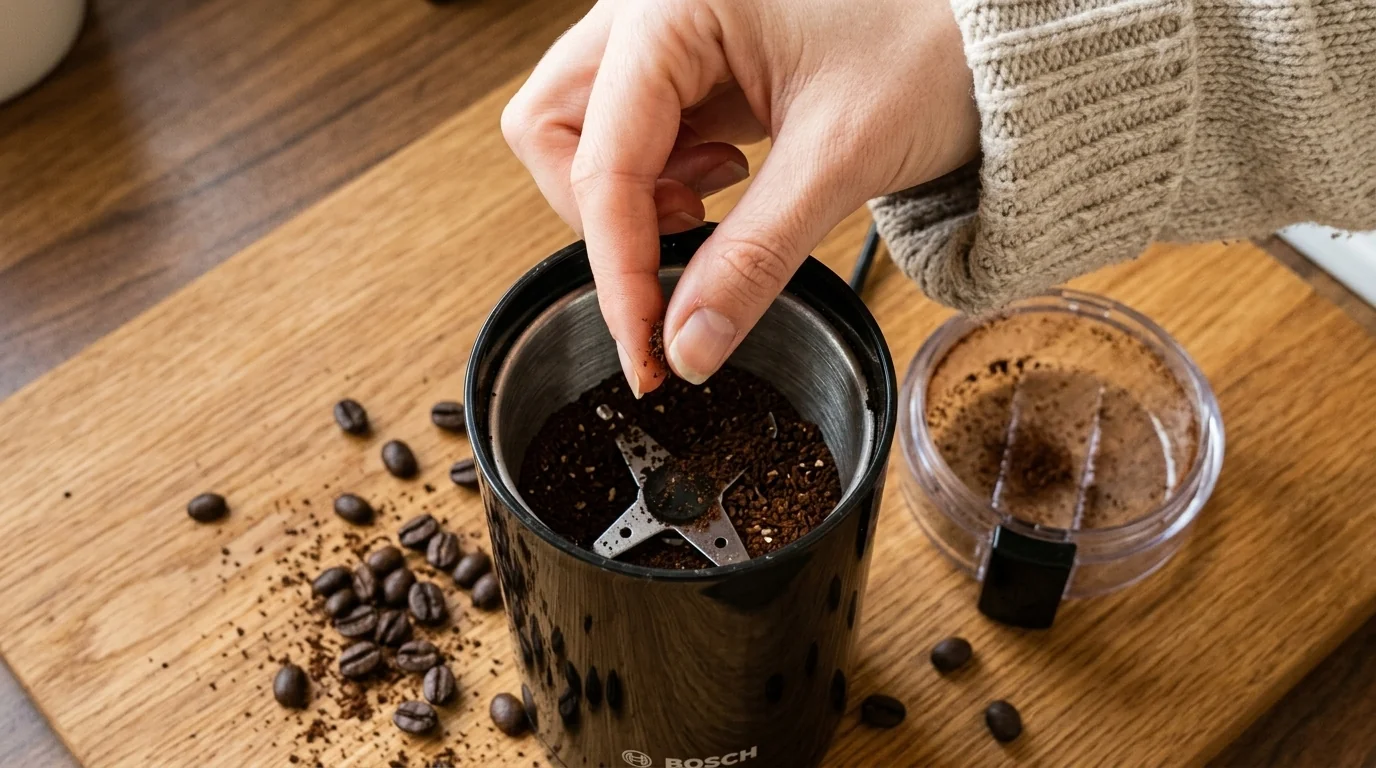
Blade grinders sell in enormous numbers because they are cheap and they grind something. They are perfectly good at coarsely chopping spices, nuts and drip-coffee beans. They are simply the wrong tool behind an espresso basket, and a manual burr mill at a similar price shows why: forty defined steps turn the same bean into espresso, pour-over or moka-pot grounds on demand.
The Pressurized Basket Is a Safety Net, Not a Solution
So why do inexpensive machines ship with the ability to make crema from supermarket pre-ground coffee? The answer is a pressurized dual-wall basket. Instead of the coffee puck providing all the resistance, a second wall with a single tiny pinhole sits underneath it and mechanically forces the liquid into a foam. The crema is real foam, but it is manufactured by a hole, not extracted from the coffee.
A pressurized basket is a genuine convenience for a beginner and a legitimate way to start. It becomes a ceiling the moment you want to improve, because it hides the puck's behaviour: a bad grind still produces a creamy-looking shot. The upgrade rule is therefore simple and non-negotiable — before you switch from a pressurized basket to a standard single-wall basket, make sure a burr grinder with micro-adjustment is already on the counter.
5. The Grinder Lineup: Every Mill Worth Knowing
Electric Blade Grinders — Where They Belong and Where They Do Not
Every grinder in this group is a blade chopper, and the same verdict applies to all of them: capable, cheap, and unsuited to a single-wall espresso basket. The differences between them are about capacity, cleaning convenience and build quality, not about whether they can dial in espresso.
Bosch TSM6A013B
The Bosch is the default blade grinder across Europe: stainless steel impact blades, a safety interlock that only lets the blades turn with the lid fitted and the switch pressed, and a 75-gram capacity that covers a full pot. A roughly 180 W motor sits inside a compact 9 × 17 × 9 cm body with a short cord.
Getting the Best From It:
- Simple, compact and dependable, and versatile enough to handle nuts and spices as confidently as coffee.
- Short pulses with a shake between them are the trick to a finer grind — usually about three passes.
- A quick brush after each use keeps the bowl fresh and the machine ready.
- It is built for drip, French press and spice work: that is where it delivers, and it does so at a very low price.
- Keep a separate batch for spices if you grind them often, so the coffee stays clean-tasting.
Regional Model Comparison & Practical Notes: The same model is sold across Germany (around 19,99 €), France (around 15,98 €), Italy (around 17,49 €) and Spain (around 20,99 €), all on 230 V with the national plug. Averaging across those markets, it is the most widely owned grinder in this guide.
Shop this find:
- View on Amazon US
- View on Amazon UK
- View on Amazon DE
- View on Amazon FR
- View on Amazon IT
- View on Amazon ES
SHARDOR Coffee Grinder
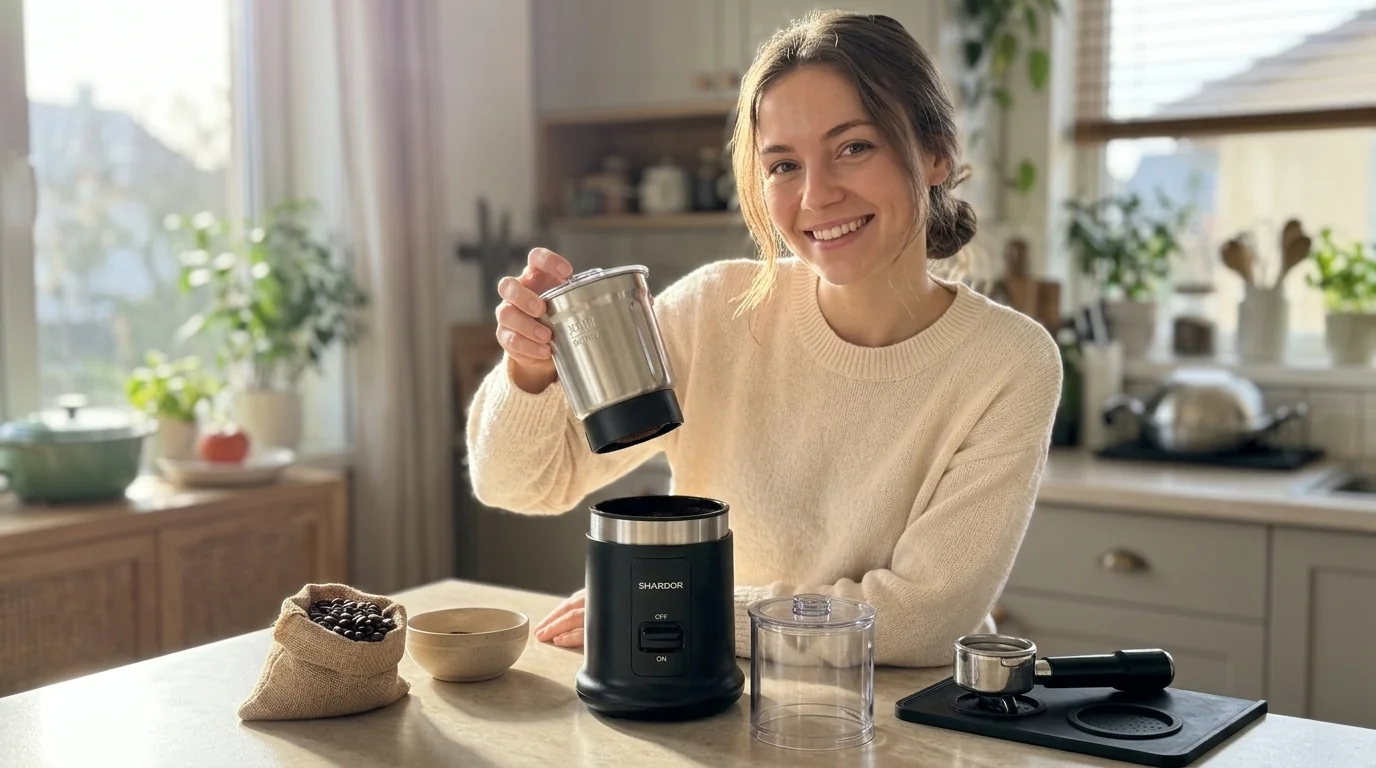
The SHARDOR is the best-equipped blade grinder of the group. Its stainless cup detaches and is dishwasher-safe, an inner lid stores the powder, the blades are upgraded 304 stainless steel, and the capacity is a full 75 grams driven by a 38,000 rpm motor. Some versions ship with two blade sets — a two-blade head for coffee and a four-blade head for wet ingredients — and the interior is metal rather than plastic.
Getting the Best From It:
- The detachable stainless cup is the feature that sets it apart: it goes straight into the dishwasher and makes decanting clean.
- 75 grams in one go covers a full pot, and the 38,000 rpm motor makes short work of beans, nuts and seeds.
- The metal interior and 304 stainless blades resist wear far better than plastic-housed rivals.
- Some versions ship with two blade sets, so one head can stay for coffee and the other for wet ingredients.
Before adding it: Buy it for drip, French press and general-purpose grinding. For espresso, the budget is better spent on a burr mill.
Shop this find:
- View on Amazon US
- View on Amazon UK
- View on Amazon DE
- View on Amazon FR
- View on Amazon IT
- View on Amazon ES
Cuisinart Coffee Grinder
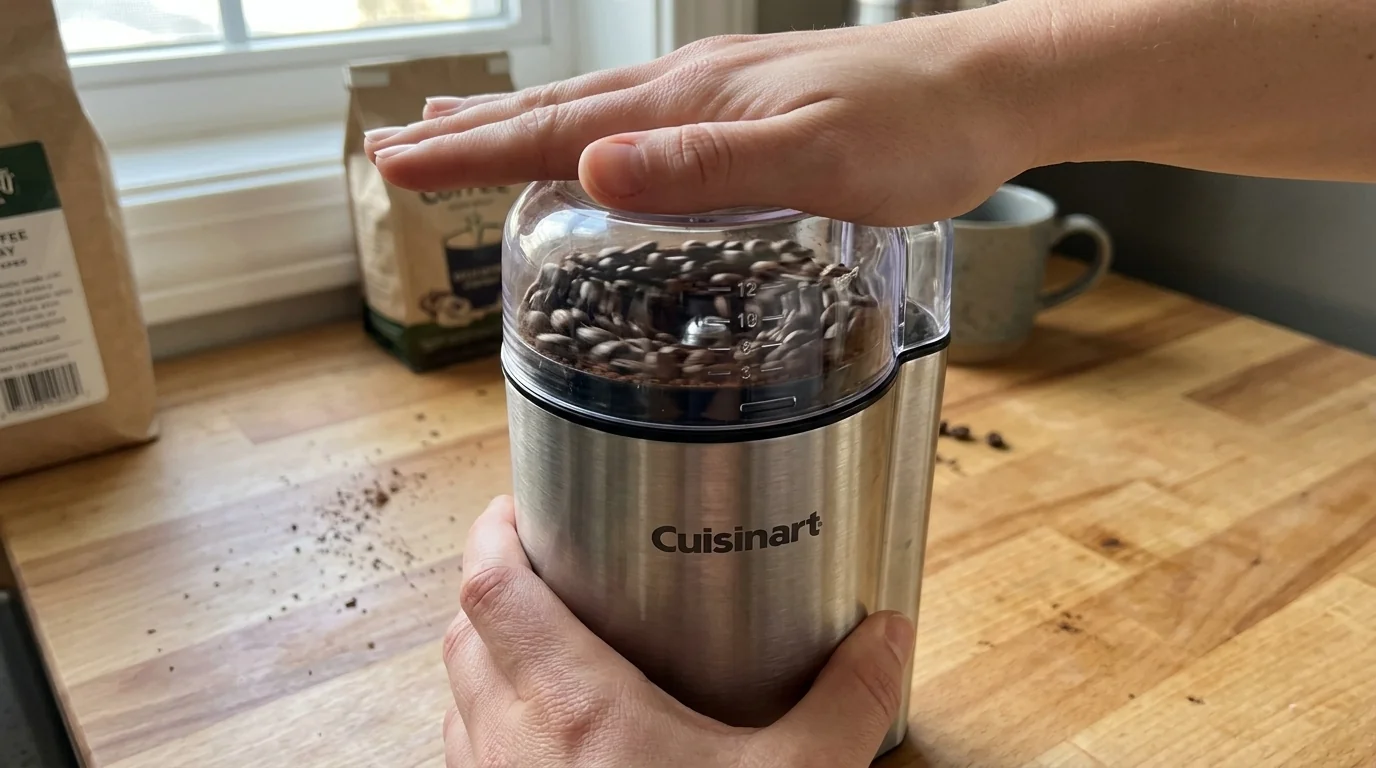
The Cuisinart is the compact English-market option: a durable stainless bowl and blades, a three-year warranty that is unusually long for the category, push-to-grind operation that reaches coarse, medium or fine within about 40 seconds, and built-in markings for one to twelve cups. Cord storage keeps the small body tidy.
Getting the Best From It:
- Durable stainless bowl and blades, backed by a three-year warranty — unusually generous for the category.
- Push to grind and reach coarse, medium or fine within about 40 seconds, with cup markings from one to twelve to guide the dose.
- Compact with onboard cord storage, so it keeps a small counter tidy.
- Best in small, fresh batches, where it grinds quickly and evenly.
Shop this find:
- View on Amazon US
- View on Amazon UK
- View on Amazon DE
- View on Amazon FR
- View on Amazon IT
- View on Amazon ES
BLACK+DECKER One Touch Coffee Grinder
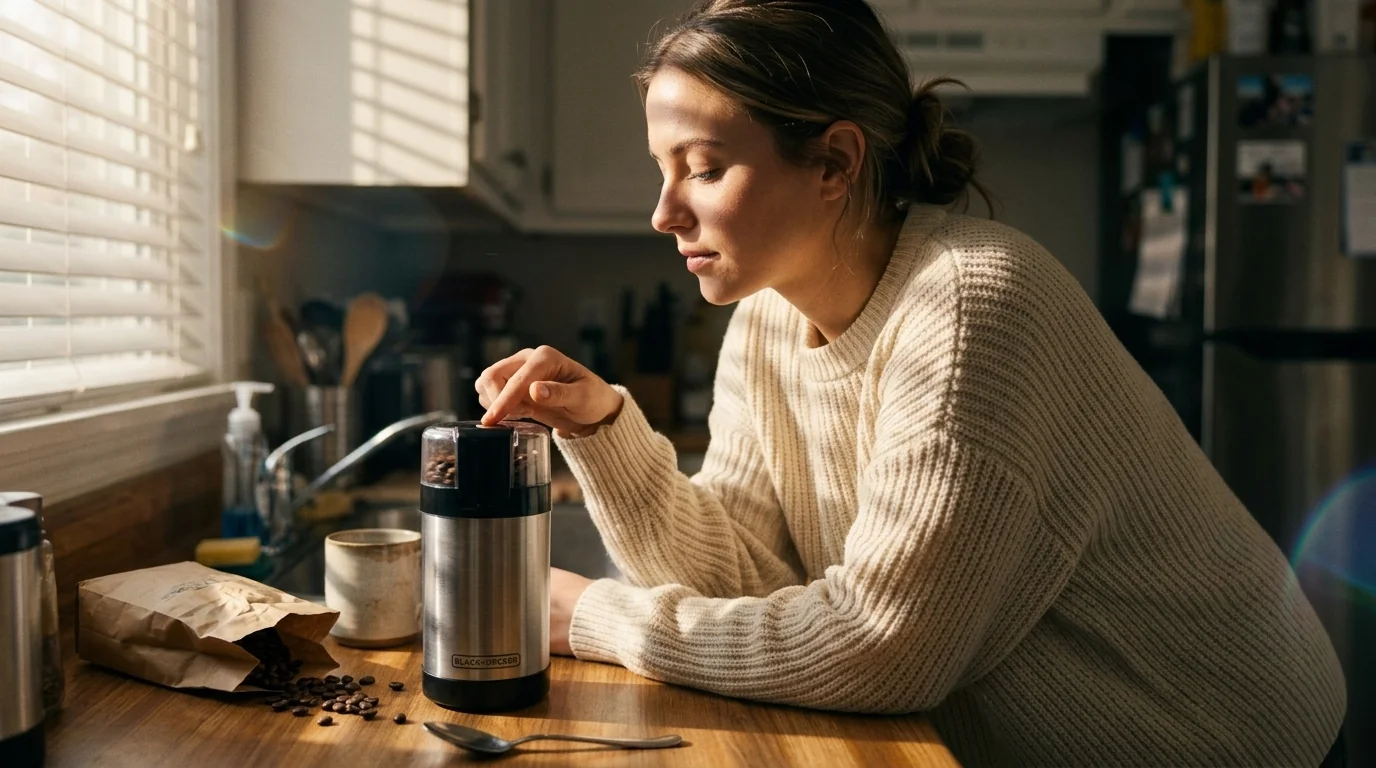
The BLACK+DECKER One Touch is the volume-selling US blade grinder: stainless steel blades and bowl, a single push-button, a lid-locking safety feature that only lets the blades turn with the lid secured, and a 2/3-cup capacity. It markets a 30 percent more uniform grind than its predecessor.
Getting the Best From It:
- The lid-locking safety and one-button control make it genuinely foolproof: the blades only turn with the lid secured.
- It earns its place beyond coffee, chopping spices, grains and herbs just as easily.
- The 2/3-cup bowl handles a full morning's grounds in one short press.
- For drip, French press and spice work it shines, and the price makes it an easy addition to any kitchen.
Before adding it: It is a drip-coffee and spice grinder. If espresso is the goal, spend the same money on a hand burr mill instead.
Shop this find:
- View on Amazon US
- View on Amazon UK
- View on Amazon DE
- View on Amazon FR
- View on Amazon IT
- View on Amazon ES
Wancle Electric Coffee Grinder
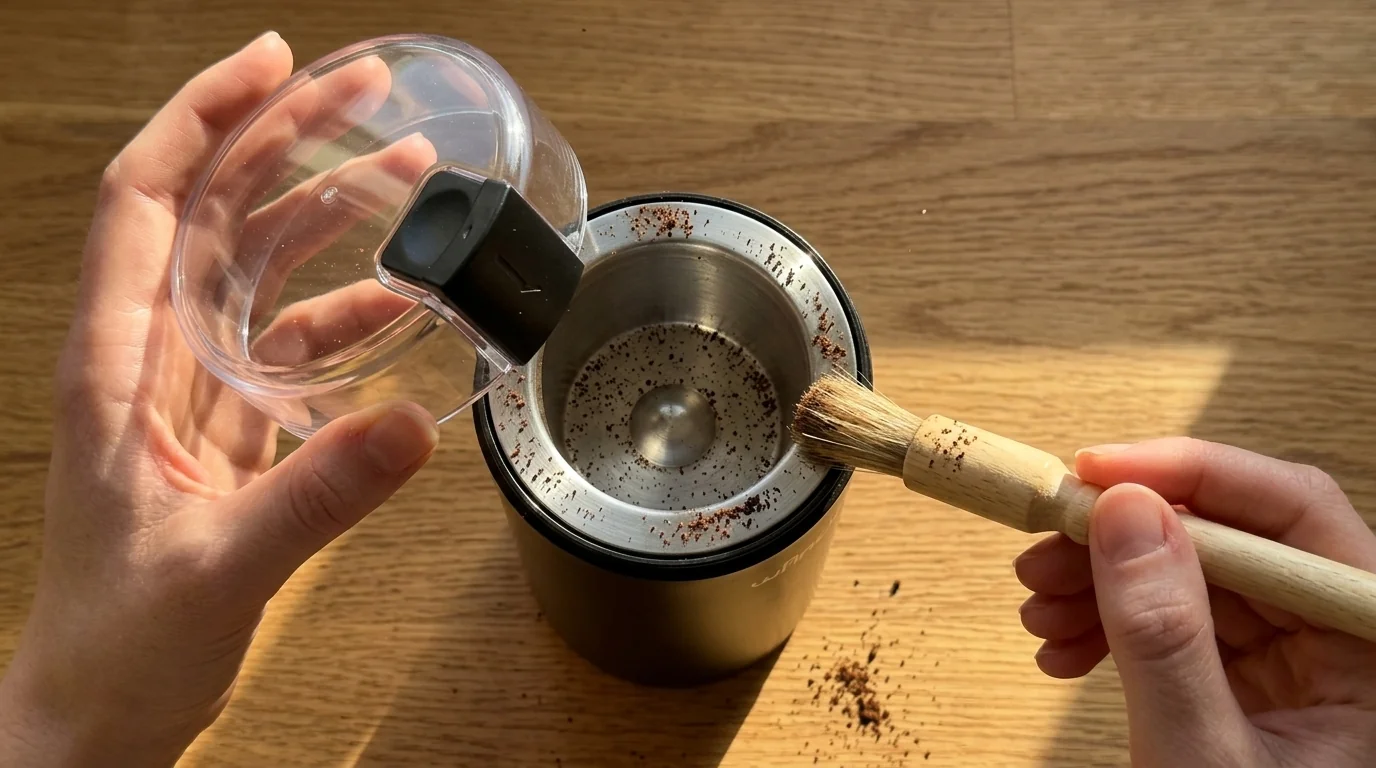
The Wancle is the cheapest grinder here: a pure copper motor driving stainless steel blades in a bowl under a transparent lid, up to 60 grams per load, with one-button operation — press to grind, release to stop. It runs at 150 W on 120 V and ships with a cleaning brush.
Getting the Best From It:
- The transparent lid lets you watch the grind develop, and one button — press to grind, release to stop — gives you control in the moment.
- A pure copper motor and a 60-gram bowl cover one or two servings with ease.
- The included brush keeps the bowl clean without any disassembly.
Shop this find:
- View on Amazon US
- View on Amazon UK
- View on Amazon DE
- View on Amazon FR
- View on Amazon IT
- View on Amazon ES
Amazon Basics Electric Coffee Grinder
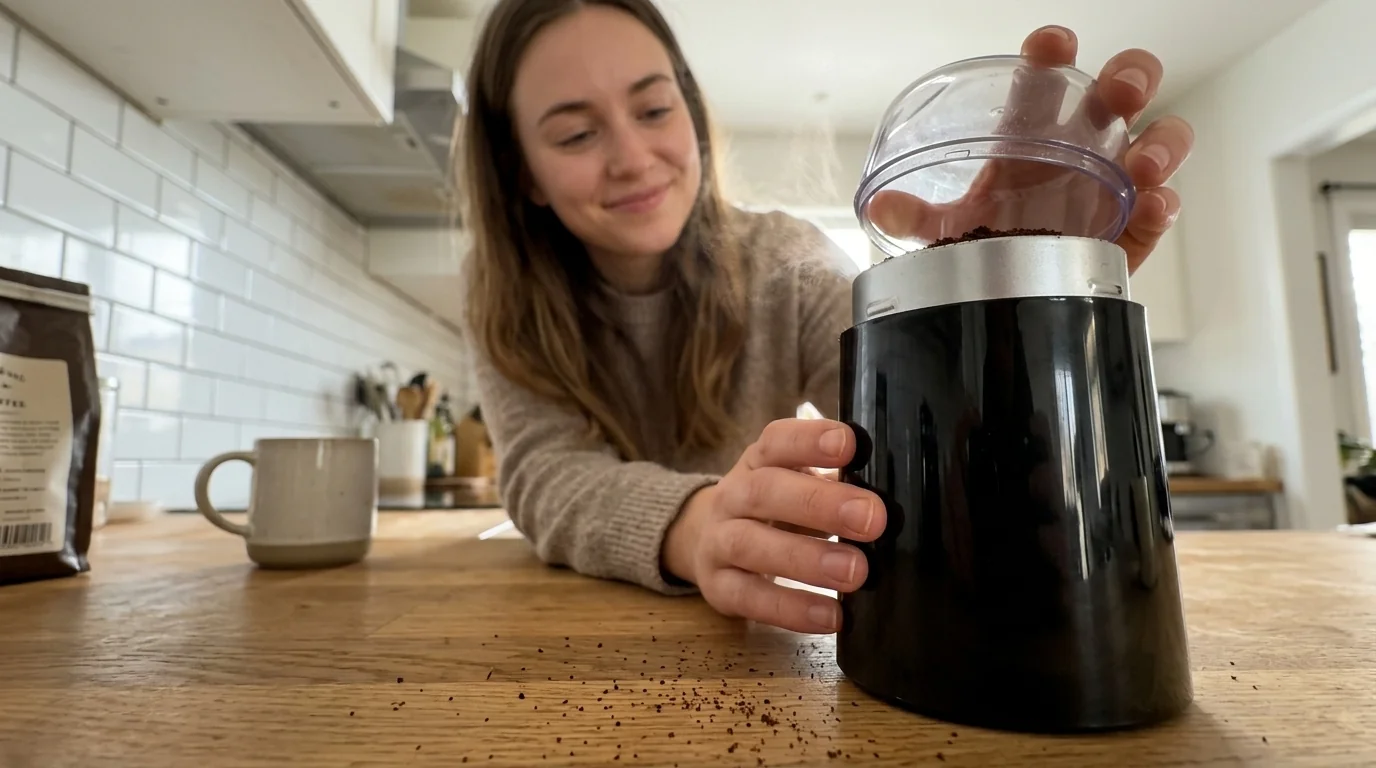
The Amazon Basics grinder is the budget staple across Europe: about 30 grams in ten seconds, stainless steel blades under a transparent safety lid, a compact body, and a roughly 200 W motor. It is suited to beans, herbs, spices and nuts, and each run should stay under 45 seconds. It is not washable.
Getting the Best From It:
- Fast, intuitive and surprisingly effective: about 30 grams in ten seconds, and the lid alone starts it.
- A dependable all-rounder for spices, nuts and seeds as well as coffee.
- Compact and inexpensive, it makes an easy second grinder to keep for dry ingredients.
- Two short passes are the trick when you want a fine grind from a blade machine.
Regional Model Comparison & Practical Notes: Sold at around 13,66 € in France, 14,95 € in Italy and 18,52 € in Spain, all 230 V. Price swings noticeably between markets and promotions, so it is worth checking rather than assuming.
Shop this find:
- View on Amazon US
- View on Amazon UK
- View on Amazon DE
- View on Amazon FR
- View on Amazon IT
- View on Amazon ES
Manual Burr Grinder — The Espresso-Capable Budget Option
OrkeyDolk Manual Coffee Grinder
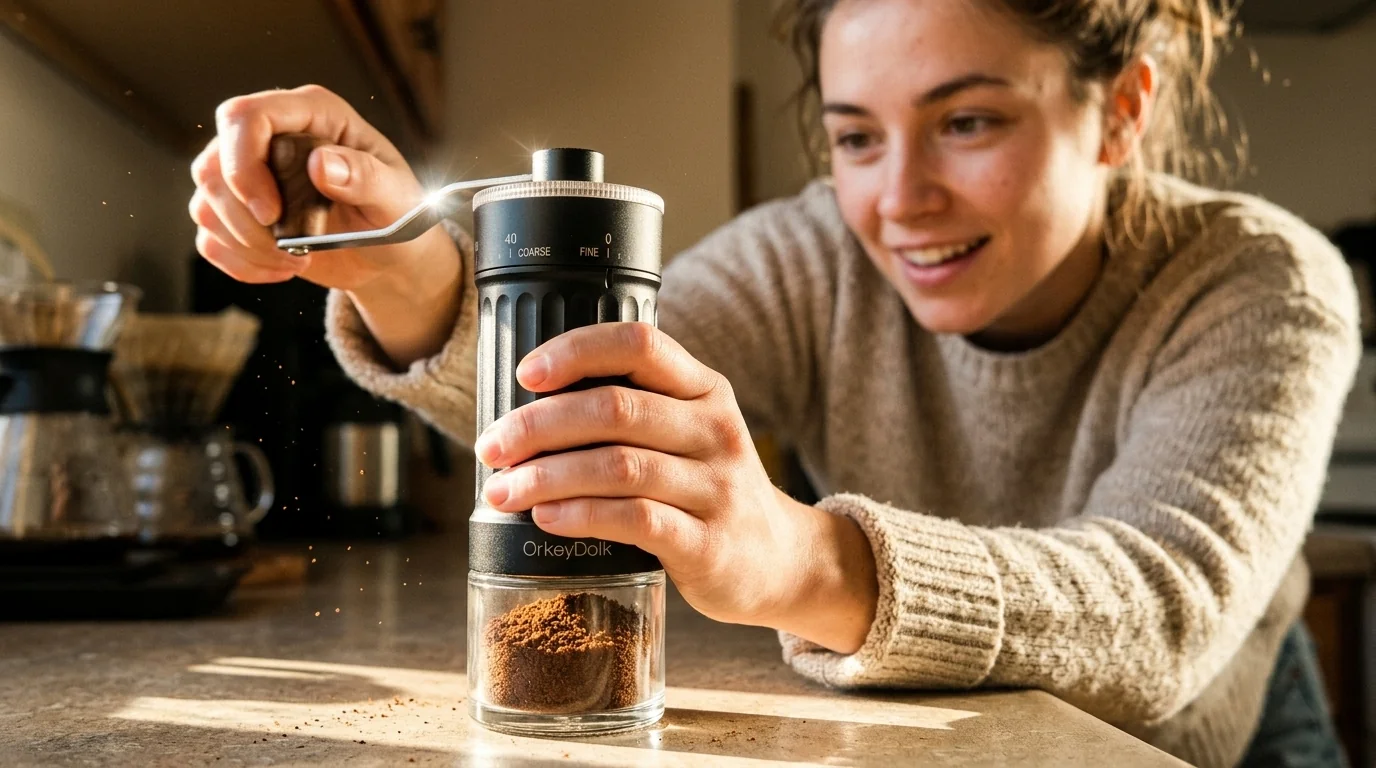
At roughly the price of a blade grinder, the OrkeyDolk does the thing blade grinders cannot: it crushes beans between a ceramic conical burr with forty external grind settings. The body weighs 325 grams and measures about 6.7 by 2.3 by 7.4 inches, the hopper takes 30 grams, and the mill breaks down into three main pieces with a removable crank and an included brush. It is designed for AeroPress, pour-over, French press and moka pot — and with the right setting, espresso.
The feeling it adds: The quiet, deliberate ritual of hand-grinding a single dose while the kettle heats.
Key Design & Functional Highlights:
- Forty external grind steps: the adjustment range that makes espresso possible at this price.
- Ceramic conical burr: generates less heat than steel or blades, protecting the aromatic oils.
- Three-piece breakdown with a crank: travels flat and cleans without tools.
Getting the Best From It:
- Forty external steps on a ceramic conical burr bring real espresso adjustment down to hand-grinder money.
- The grind setting is easy to read and holds steady through the grind — no drift, which is the flaw that plagues cheap copies.
- Three pieces and a removable crank mean it travels flat and cleans without tools.
- For the very finest espresso grind, from the zero mark you can lift the adjustment ring and continue toward the fine end to unlock the mill's hidden step.
- A 25-gram dose takes one to two minutes at espresso fineness — a peaceful part of the morning ritual, especially for one or two drinks.
Before adding it: If hand-grinding every morning would become a chore, this is the point to step up to an electric burr grinder instead. It pairs best with one or two drinks a day.
Shop this find:
- View on Amazon US
- View on Amazon UK
- View on Amazon DE
- View on Amazon FR
- View on Amazon IT
- View on Amazon ES
6. Grinder Comparison: Key Specs Side by Side
| Model | Type | Key specifications |
|---|---|---|
| Bosch TSM6A013B | Electric blade grinder | Approx. 180 W · stainless steel impact blades · safety interlock · 75 g capacity · 9 × 17 × 9 cm body |
| SHARDOR | Electric blade grinder | 38,000 rpm · 304 stainless blades · detachable dishwasher-safe cup · 75 g · metal interior · two-year warranty |
| Cuisinart | Electric blade grinder | Stainless bowl and blades · push-to-grind, coarse to fine in about 40 s · 1–12 cup markings · cord storage · three-year warranty |
| BLACK+DECKER One Touch | Electric blade grinder | 150 W · stainless blades and bowl · lid-locking safety · 2/3 cup capacity |
| Wancle | Electric blade grinder | 150 W at 120 V · pure copper motor · stainless blade and bowl · transparent lid · 60 g capacity |
| Amazon Basics | Electric blade grinder | Approx. 200 W · 30 g in about 10 s · stainless blades · transparent safety lid · not washable |
| OrkeyDolk | Manual burr grinder | 40 external grind steps · ceramic conical burr · 30 g capacity · 325 g · three-piece breakdown · AeroPress, pour-over, moka and espresso |
7. Standalone Grinder vs Built-In Grinder
Once you accept that the grinder matters, the next decision is whether it lives inside the machine or beside it.
Counter space and outlets. An all-in-one needs one socket and a single 32 to 35 cm slot. A standalone pairing needs two sockets and enough clearance between the two for the grinder to dose straight into the portafilter without carrying it across the worktop.
Heat and bean freshness. On an all-in-one, the hopper sits above the brew group. During back-to-back drinks the residual warmth from the chassis reaches the beans and slowly accelerates the oxidation of the oils that carry aroma. A standalone grinder sits away from the heat source and keeps the beans cooler between shots.
Failure isolation and the upgrade ceiling. If the built-in grinder jams or the burrs wear, the whole machine goes in for repair — as the reports on both the La Specialista Arte and the Magnifica S illustrate, that coupling turns a grinder problem into a machine problem. With separate units, either half can be replaced on its own. Grinder lifespans tend to outlast pump lifespans, so decoupling the two protects the more durable and more flavour-critical component. Separates also let the grinder be upgraded alone, which is the upgrade that changes the cup the most.
8. Three Realistic Setups for Real Kitchens
Setup 1 — The Space-Constrained Minimalist
Hardware: De'Longhi Dedica Style EC685 (or a budget machine such as the Casabrews CM5418 or Cecotec Power Espresso 20), starting on the pressurized basket, paired with an entry-level burr grinder or a hand grinder.
The logic: the machine fits in roughly 15 cm of worktop, the grinder lives wherever there is a spare socket, and the entry price stays low. Milk-based drinks are the target, and the manual steam wand is enough for that once you have practised the angle.
Where it stops: you are buying a good first routine, not a bottomless-portafilter hobby platform.
Setup 2 — The All-in-One Home Barista
Hardware: Breville Barista Express, or De'Longhi La Specialista Arte.
The logic: a dedicated coffee corner of 40 cm or more and a wish to learn the full grind-dose-tamp-steam sequence without hunting for compatible parts. Both machines cover temperature control, a usable grinder and a capable steam wand in one body.
Where it stops: the stepped built-in grinder limits how finely a light roast can be dialled, and the grinder cannot be upgraded without replacing the machine.
Setup 3 — The Zero-Fuss One-Touch Household
Hardware: Philips 2200 Series Panarello, or a comparable bean-to-cup such as the De'Longhi Magnifica S.
The logic: several people drinking several cups a day, nobody willing to clean a portafilter, and a firm preference for pressing one button and walking away. The frother is a separate spout rather than a steam wand, so milk texturing is simple rather than expressive.
Where it stops: no bottomless portafilter, no precise dose control and no flavour experiments — the machine decides the extraction and you choose the drink.
9. Feature Audit: What Is Worth Paying For
Worth the Money
- Digital PID temperature control. Locking the brew water within roughly ±1 °C removes the swings that make one shot taste thin and the next taste scorched. It is the most valuable control on any machine.
- Low-pressure pre-infusion. A gentle wetting phase before full pressure reduces the chance of channeling, so the puck is saturated evenly instead of being punched through at the first contact.
- A standard portafilter diameter (51, 54 or 58 mm) with a metal tamper. The plastic combination scoop-and-tamper that ships in the box bends under real pressure and tampes unevenly; on more than one machine in this guide it is also the first part to break. A solid metal tamper that matches the basket is the foundation of a level puck.
- A fully articulated steam wand. The ability to angle the wand is what makes stable microfoam and latte art possible; a fixed frothing nozzle cannot.
- A removable brew group or a removable grinder cup. Whatever can be taken out and rinsed is what keeps the machine hygienic and serviceable over years.
Worth Ignoring
- "20 bar" pressure claims. Espresso sits at roughly 9 bar at the group head, and any higher pump pressure is capped by an over-pressure valve. The bigger number is a spec-sheet flourish, not a flavour upgrade.
- "Espresso-ready" on a blade grinder's box. The label is marketing. The physics of a spinning blade has not changed.
- Elaborate full-colour touchscreens with no real temperature control. They add circuit complexity, boot delay and failure points. Physical buttons and a machined dial are more durable in a kitchen.
10. Where the Machine and Grinder Fit in Your Setup
The machine and grinder are the infrastructure; everything around them is the workflow.
- Once the two are chosen, the next decisions are the accessories that sit around them — the dosing ring diameter, WDT needle length, 0.1 g scale and tamper size. Those are covered in How to Build an Espresso Setup: What You Actually Need for a Smooth Home Workflow.
- For the space itself — heat clearance around the machine, water-tank pull-out height, socket routing and protecting the counter surface — see How to Build a Home Coffee Bar: Space, Storage, and Station Flow.
Frequently Asked Questions
I already own a blade grinder. Can it make espresso at all?
Behind the machine's original pressurized basket, it can push out a strong, crema-topped coffee-like drink, because the basket's pinhole supplies most of the resistance. It must never be used with a standard single-wall basket, where the irregular grind will reliably cause severe channeling or choke the machine outright.
Why is an all-in-one's built-in grinder often described as an upgrade bottleneck?
Built-in grinders usually adjust in visible steps rather than continuously, so a switch to a lighter roast can land between two settings — one that runs too fast and one that stalls the shot. They also sit close to the machine's internal heat, which warms the beans over a long session, and they generally cannot be removed for a deep clean.
What is the real difference between 51 mm, 54 mm and 58 mm portafilters at home?
The diameter sets the depth and area of the coffee bed. A 51 mm basket makes a deeper, more forgiving puck but has a narrower accessory ecosystem; 54 mm is the balanced middle ground used by Breville-style machines; 58 mm is the commercial standard with the widest accessory range, but it demands the most even distribution because the bed is shallower.
Why can't I brew another coffee immediately after steaming milk?
A single thermoblock or boiler runs steam at roughly 130 °C but brews at roughly 93 °C. After frothing, the system must purge or cool before it can brew again; skipping that step sends water hot enough to scorch the coffee straight onto the puck, which is why machines with this design ask you to wait or run a cooling flush.
The portafilter feels very tight, or will not sit square, on a new machine. Is it faulty?
Usually not. The food-grade silicone gasket at the group head is stiff when new and settles over the first weeks of use. Lock the portafilter in firmly without forcing it past its natural stop, brew a few shots, and the seal relaxes into place; if it is still binding after that, check that the basket is seated fully in the portafilter.
How much should I spend on the machine versus the grinder?
At the entry level, split the budget as evenly as the market allows, because a mid-range grinder paired with a budget machine beats the reverse every time. As the budget grows, the grinder reaches its practical ceiling long before the machine does, so the machine can absorb the larger share — but never let a beautiful machine crowd out an espresso-capable grinder.