A useful home coffee bar does not require extensive kitchen marble, built-in plumbing, or dozens of barista accessories. Its primary purpose is straightforward: eliminating daily friction from your morning coffee routine. When coffee stations fail, the problem is rarely an underpowered espresso machine or a lack of tools. More often, it is an overcrowded counter where accessories compete for space with cutting boards and meal preparation.
The most practical coffee station is planned around five tangible factors: your actual brewing routine, your available counter space, how frequently you brew, what needs to be stored away, and how smoothly your physical workflow moves from bean to cup. If an accessory does not directly solve a problem in that sequence, it does not belong on your primary counter.
⚡Quick Comparison MatrixClick to ExpandAt a Glance: Practical Coffee Bar Setup Essentials
Expand TableCollapse Table
At a Glance: Practical Coffee Bar Setup Essentials
| Product | Category | Regional Models & Pricing Snapshot | Core Specs & Highlights | Friction Point Solved |
|---|---|---|---|---|
| Maestri House S2 Espresso Coffee Scale | Precision Scale | US: Maestri House S2 (approx. $27.07) · UK: Ataller Mini (approx. £10.98) · DE: Maestri House S2 (ca. 29,98 €) · FR: KitchenTour 3kg (env. 30,48 €) · IT: RENPHO Slim (circa 14,99 €) · ES: BAGAIL Timer (aprox. 38,19 €) | 4.13×4.13×0.78-inch footprint, 0.1g precision, auto/manual timer, 500 mAh USB-C, silicone heat pad | Oversized kitchen scales that cannot fit onto espresso drip trays or crowd narrow counters |
| Breville 54mm Dosing Funnel (BEA201NEU) | Dosing Collar | US: Breville 54mm (approx. $17.95) · UK: PEUTIER 54mm (approx. £8.99) · DE: YiPHomn 51mm (ca. 6,99 €) · FR: NEOUZA 54mm (env. 16,78 €) · IT: KNODOS Magnetic (circa 23,99 €) · ES: Futuhada (aprox. 5,98 €) | 54mm twist-to-lock collar, BPA-free polymer, direct grinder cradle clearance, dishwasher safe | Coffee grounds spilling over portafilter rims during grinding and distribution |
| Adorever 12oz Stainless Steel Milk Pitcher | Steaming Pitcher | US: Adorever 12oz (approx. $8.49) · UK: PLACHIDAY 350ml (approx. £7.99) · DE: BASECENT 350ml (ca. 6,98 €) · FR: NewGF 350ml (env. 10,99 €) · IT: Barista Legends (circa 16,97 €) · ES: UMUACCAN (aprox. 11,99 €) | 304 food-grade stainless steel, internal laser oz/ml volume markings, pointed pour spout | Bulky commercial pitchers taking up counter space and wasting milk on individual drinks |
| Veken 22oz Airtight Coffee Canister with Window | Whole Bean Storage | US: Veken 22oz (approx. $31.99) · UK: Fentar 1100ml (approx. £13.99) · DE: KC Kitchen 1kg (ca. 33,95 €) · FR: KC Kitchen 1kg (env. 34,95 €) · IT: Lavatelli ProntoCaffè (circa 11,90 €) · ES: ACOMTUO 1.8L (aprox. 13,99 €) | One-way CO2 release valve, clear acrylic monitoring window, calendar date tracker wheel, stainless scoop | Bean oxidation, forgotten roast dates, and constantly opening lids to check remaining levels |
| Mind Reader 13-Inch Coffee Bar Organizer | Countertop Organizer | US: Mind Reader 13" (approx. $15.39) · UK: ANBOXIT Station (approx. £17.99) · DE: LEMIKKLE 2-Tier (ca. 27,99 €) · FR: VITVITI Inox (env. 25,99 €) · IT: Acropaq Station (circa 25,03 €) · ES: JUPPLIES 2-Pack (aprox. 16,99 €) | 13×6.4×11.5-inch vertical profile, 6 divided compartments, durable lightweight resin, easy-wipe finish | Small coffee accessories, stirrers, and filters scattering across open prep surfaces |
Prices and availability subject to change. Affiliate links may earn a commission at no extra cost to you.
Start With Your Coffee Routine, Not the Decor
Before purchasing organizers, decorative trays, or accessory racks, map out the mechanical steps of your normal morning coffee preparation. Equipment priorities diverge significantly depending on your brew method.
Espresso-Focused Setup
An espresso routine is tool-intensive and demands sequential station planning:
- Espresso Machine: The physical centerpiece requiring dedicated electrical supply and overhead clearance for refilling the water reservoir.
- Grinder: Positioned immediately adjacent to the machine to minimize transfer distance.
- Coffee Scale: Essential for weighing whole-bean doses and tracking liquid extraction yield in real time.
- Tamper: Required for compressing grounds into an even, level puck.
- Dosing Funnel: High-utility tool to catch static-charged coffee grounds exiting the grinder chute.
- Milk Pitcher: Necessary if you prepare flat whites, lattes, or cappuccinos.
- Knock Box: Keeps spent espresso puck disposal localized rather than requiring messy trips across the kitchen to the trash can.
- WDT Distribution Tool: A fine-needle stirrer that breaks up ground clumps to minimize channeling (beneficial for unpressurized baskets, but optional on day one).
Pour-Over-Focused Setup
A manual pour-over station prioritizes different physical clearances:
- Gooseneck Kettle: Requires dedicated counter space near a power outlet, with vertical clearance for high pouring arcs.
- Coffee Scale: Tracks brew water weight and brew time simultaneously.
- Brewer & Carafe: A V60, Kalita Wave, or glass server.
- Coffee Storage: Dry, accessible storage for whole beans and paper filters away from steam and sink splashes.
A pour-over setup eliminates the need for tampers, dosing collars, and knock boxes, requiring substantially less horizontal space.
Casual Coffee Setup
If your daily routine relies on a drip machine, a French press, or a single-serve capsule machine, you do not need a commercial-style barista station. Introducing espresso-specific gadgets into a casual routine merely creates clutter. Prioritize clean bean storage, a reliable mug shelf, and a compact waste bin rather than specialized puck-preparation tools.
How Much Counter Space Do You Actually Need?
Counter space should always be measured and budgeted before purchasing accessories. A common mistake is buying storage units that consume the very workspace needed to prepare a drink.
The Dimensions That Actually Matter
When planning a coffee station footprint, evaluate four spatial dimensions:
- Width: Standard domestic counters offer varied widths. A dedicated, comfortable espresso setup typically occupies 24 to 36 inches of linear width. In compact apartments, an efficient footprint can be compressed down to 18 to 24 inches by nesting tools.
- Depth: Standard kitchen counters measure approximately 24 to 25 inches deep. Most domestic espresso machines and grinders occupy 11 to 15 inches of depth, leaving roughly 9 to 12 inches of front staging room for scales, dosing funnels, and tampers.
- Overhead Height & Cabinet Clearance: Standard upper cabinets hang 18 inches above the countertop. If your machine features a top-loading water tank or your grinder has a tall bean hopper, check that you have sufficient vertical clearance to load beans and pour water without sliding heavy equipment forward every morning.
- Vertical Organization: Using vertical space above or beside equipment prevents loose items from sprawling across horizontal surfaces.
Real Countertop Footprints from Collected Research
Evaluating the physical dimensions of core coffee tools demonstrates how quickly counter space is consumed:
- Ultra-Compact Scale (Maestri House S2): Measures 4.13 × 4.13 × 0.78 inches. Its sub-5-inch square profile allows it to live permanently on an espresso drip tray without occupying separate counter space.
- Vertical Station Organizer (Mind Reader): Measures 13 × 6.4 × 11.5 inches. Its narrow 6.4-inch depth allows it to sit flush against the backsplash, while its 11.5-inch height uses vertical space to store cups and condiments without consuming prep room.
- Airtight Bean Canister (Veken 22oz): Cylindrical footprint designed for upright countertop storage, holding up to 22oz of whole beans while requiring minimal horizontal surface.
- Compact Milk Pitcher (Adorever 12oz): Scaled with a narrow base for individual drinks, requiring significantly less staging room than bulky 20oz or 32oz commercial pitchers.
- Dosing Funnel (Breville 54mm): Mounts directly onto the portafilter rim, adding under an inch of height while occupying zero additional counter footprint when stored atop the machine.
The Core Tools Worth Keeping Within Reach
Every tool resting on your prime prep surface must earn its space by solving an active daily friction point. The following items represent the most functional daily-use tools.
1. Coffee Scale
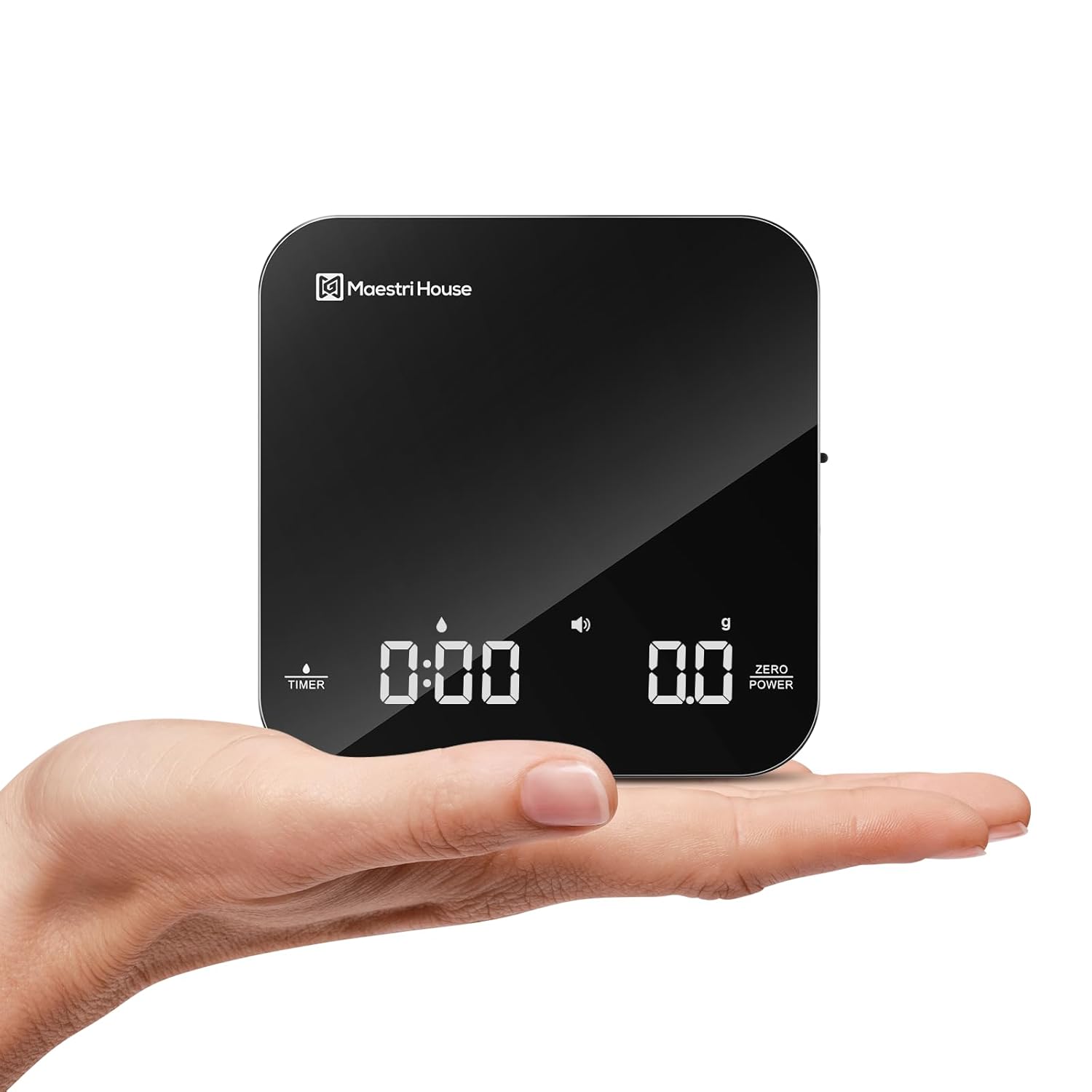
A digital coffee scale is the single most impactful diagnostic tool for both espresso and pour-over brewing. It replaces guesswork with repeatable metrics.
- Why It Matters: Volumetric lines on shot glasses or scoops fluctuate wildly due to bean density and crema expansion. Measuring dry coffee doses (e.g., 18.0g) and liquid extraction yields (e.g., 36.0g) by weight ensures consistent strength and extraction balance.
- What to Look For: 0.1g resolution, an integrated timer, a compact footprint that fits between group head pillars, and moisture resistance. A higher resolution beyond 0.1g does not improve coffee flavor and often introduces unstable, drifting readings on vibrating drip trays.
Product Card: Maestri House S2 Espresso Coffee Scale with Timer
- Current Price: $27.07
- Rating: 4.4 out of 5 stars
- Review Count: 4,498
- Bought in Past Month: Amazon currently shows 7K+ bought in the past month
- Key Specs: 4.13 × 4.13 × 0.78 inches; 0.75 lb; 0.1g precision across 0.5g–2000g; automatic and manual timing modes; 500 mAh USB-C rechargeable battery; waterproof borosilicate glass platform with removable heat-insulating silicone pad.
- Best For: Espresso machine drip trays and compact manual pour-over stands.
- Why It Stands Out: Its 4.13-inch square dimension fits onto shallow domestic drip trays where standard kitchen food scales cannot sit flat. Dual auto-timing modes automatically detect liquid flow initiation.
- Potential Limitation: Its small platform cannot comfortably support large mixing bowls or wide 8-cup carafes; the silicone pad must be seated completely flat to prevent 0.2g calibration shifts during pump vibration.
- Marketplace: US (amazon.com)
- Amazon Search Link: Search Maestri House S2 Espresso Scale on Amazon
Regional Model Comparison & Practical Barista Notes
- US & Germany (Maestri House S2 Ultra-Mini): Engineered specifically for tight clearance machines (such as Breville Bambino, Gaggia Classic, or De'Longhi Dedica). The physical power switch on the side prevents accidental battery drain during long standby periods. Ensure the silicone mat is seated flat; uneven placement can cause 0.2g calibration shifts during high-vibration extraction cycles.
- UK (Ataller Mini Scale with Timer): A budget-conscious micro scale offering 0.1g resolution and tactile mechanical buttons. The tactile feedback is especially practical when hands are wet or powdery.
- France, Italy & Spain (KitchenTour & RENPHO Ultra-Slim Editions): Popular European alternatives providing broad tare support and slim vertical clearance for classic Italian moka pot and single-group espresso workflows.
Before adding it: Measure the clear distance between your portafilter spouts and the drip tray surface. Ensure your tallest espresso cup plus 0.8 inches of scale clearance will comfortably fit beneath the group head.
Shop this find:
- Check availability on Amazon US
- Check availability on Amazon DE
- Check availability on Amazon UK
- Check availability on Amazon FR
- Check availability on Amazon IT
- Check availability on Amazon ES
2. Dosing Funnel
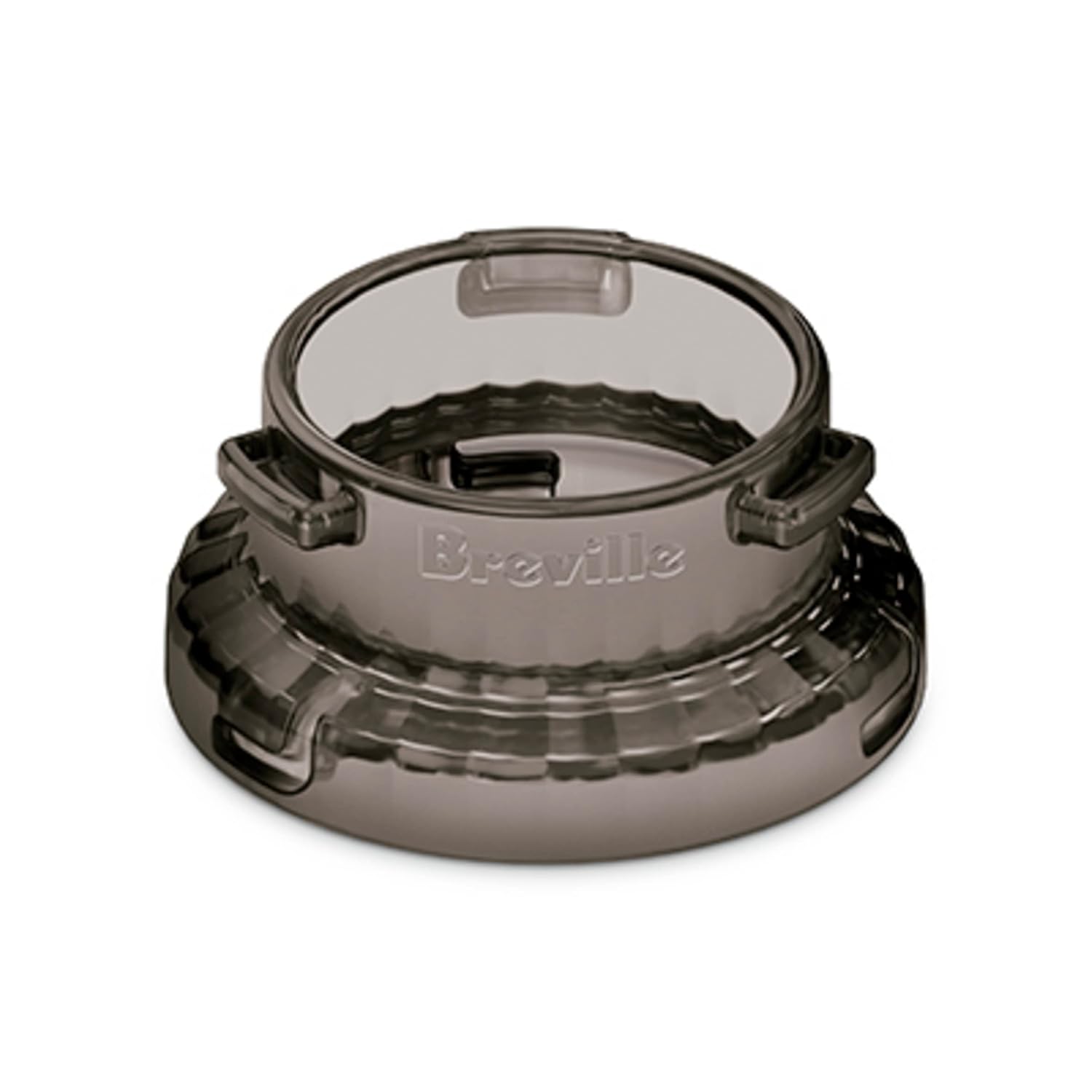
Grinding coffee directly into an open portafilter frequently creates a fluffy, static-charged mound that spills over the basket rim, scattering grounds across the counter.
- Why It Matters: A dosing funnel acts as a temporary wall extension, catching grounds as they drop from the grinder chute. It allows you to distribute grounds or tap the portafilter without coffee spilling onto the counter.
- Compatibility Warning: Dosing collars are not universally interchangeable. Portafilters range strictly across 51mm, 54mm, and 58mm sizes. Never purchase a dosing funnel based on product name alone; verify the exact basket diameter of your specific machine brand.
Product Card: Breville 54mm Dosing Funnel (BEA201NEU)
- Current Price: $17.95
- Rating: 4.7 out of 5 stars
- Review Count: 1,277
- Bought in Past Month: Amazon currently shows 1K+ bought in the past month
- Key Specs: 54mm twist-to-lock collar; BPA-free food-contact polymer; engineered for direct grinder cradle clearance; dishwasher safe.
- Best For: Owners of 54mm Breville/Sage espresso machines seeking mess-free grinding and puck distribution.
- Why It Stands Out: Twists firmly onto portafilter lugs, allowing the user to push the portafilter into integrated grinder cradles to activate grinding without the funnel falling off.
- Potential Limitation: Strictly compatible with 54mm Breville/Sage portafilters (Barista Touch, Barista Pro, Barista Express, Bambino Plus); will not fit 51mm De'Longhi or 58mm commercial group heads. Must be unclipped before using standard 53.3mm tampers.
- Marketplace: US (amazon.com)
- Amazon Search Link: Search Breville 54mm Dosing Funnel on Amazon
Regional Model Comparison & Practical Barista Notes
- US, UK & Germany (Breville/Sage Official 54mm Collar): Designed exclusively for 54mm Breville/Sage portafilter baskets (Barista Touch, Barista Pro, Barista Express, Bambino Plus). Note that this funnel must be removed before inserting standard 53.3mm tampers unless using an under-rim distributor.
- France, Italy & Spain (NEOUZA & KNODOS Magnetic Stainless Steel Rims): For machines using traditional commercial 58mm group heads (E61, Gaggia, Rocket, ECM) or 51mm machines (De'Longhi Dedica), magnetic stainless steel rings provide universal weighted stability across different basket brands.
Before adding it: Verify your portafilter diameter before purchasing. Portafilters range strictly from 51mm to 58mm; a 54mm funnel will not fit 51mm De'Longhi or 58mm commercial group heads.
Shop this find:
- Check availability on Amazon US
- Check availability on Amazon DE
- Check availability on Amazon UK
- Check availability on Amazon FR
- Check availability on Amazon IT
- Check availability on Amazon ES
3. Milk Pitcher
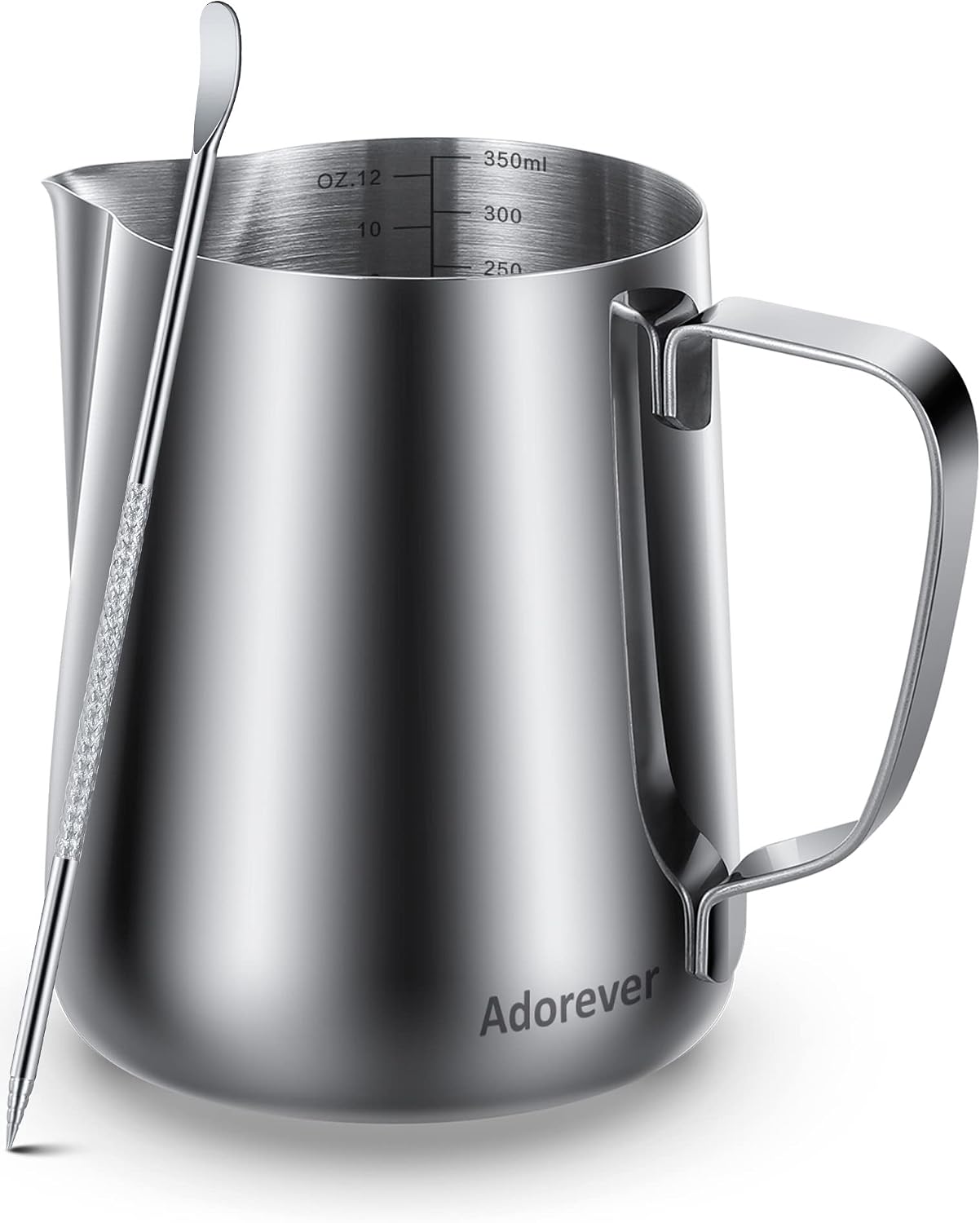
For milk-based drinks (lattes, cappuccinos, flat whites), keeping a properly sized frothing pitcher beside the steam wand streamlines the morning routine.
- Why Capacity Choice Matters: Domestic espresso steam wands possess lower boiler volume and steam pressure than commercial machines. Using a large 20oz or 32oz pitcher forces you to pour in excess milk just to submerge the steam tip, resulting in daily milk waste. A 12oz (350ml) pitcher provides the ideal depth-to-volume ratio for steaming 4oz to 6oz of cold milk into glossy microfoam.
Product Card: Adorever 12oz Stainless Steel Milk Frothing Pitcher
- Current Price: $8.49
- Rating: 4.7 out of 5 stars
- Review Count: 12,538
- Bought in Past Month: Amazon currently shows 6K+ bought in the past month
- Key Specs: 12oz (350ml) capacity; food-grade 304 stainless steel; laser-etched interior dual oz/ml volume markings; tapered pointed pouring spout; dishwasher safe; includes latte art pen.
- Best For: Single-serving flat whites, cortados, and 6–8oz cappuccinos on home espresso machines.
- Why It Stands Out: Narrow conical base allows low-volume domestic steam wands to create an energetic whirlpool with minimal milk volume. Internal measurements prevent overfilling.
- Potential Limitation: 12oz capacity cannot texture enough milk for two large mugs simultaneously; those making multiple drinks in a single pass will require a 20oz size.
- Marketplace: US (amazon.com)
- Amazon Search Link: Search Adorever 12oz Milk Frothing Pitcher on Amazon
Regional Model Comparison & Practical Barista Notes
- US & UK (Adorever & PLACHIDAY 350ml Pitchers): Standard mirror-polished or matte black stainless construction with comfortable curved handles. The 12oz capacity accommodates standard 150ml to 200ml milk beverages with sufficient expansion headspace for dense foam.
- Germany, France, Italy & Spain (BASECENT & Barista Legends Inox Sets): European models emphasize certified food-grade 304 stainless steel with dishwasher compatibility. For plant-based milks (oat, almond), keeping the pitcher chilled in the refrigerator before steaming extends texturing time for silkier microfoam.
Before adding it: If you frequently steam milk for two large 12oz mugs simultaneously, step up to a 20oz pitcher. For individual servings, the 12oz version preserves precious counter space and ensures optimal steam wand depth.
Shop this find:
- Check availability on Amazon US
- Check availability on Amazon DE
- Check availability on Amazon UK
- Check availability on Amazon FR
- Check availability on Amazon IT
- Check availability on Amazon ES
4. Knock Box
Spent espresso pucks are wet, hot, and compacted under pressure. Disposing of them without a designated station introduces mess to the kitchen.
- Why It Matters: Banging a heavy metal portafilter against a plastic kitchen trash bin risks cracking the bin rim, denting the portafilter ears, or dropping the filter basket into the garbage. A countertop knock box features a rubberized, shock-absorbing strike bar that absorbs mechanical impact and keeps wet grounds contained.
- Countertop Footprint Considerations: Choose a compact circular or square bin (typically 4 to 5 inches wide) that tucks beside the machine or rests beneath the group head. Emptying a smaller knock box every 1 to 2 days also prevents mold growth compared to leaving grounds in a large bin for weeks.
Use Storage to Keep the Coffee Bar From Taking Over Your Kitchen
Without deliberate organizational boundaries, coffee supplies quickly creep across the kitchen. The solution is defining distinct storage layers:
- Daily Working Surface: Reserved exclusively for active tools (machine, grinder, scale, tamper, pitcher).
- Intermediate Storage: A compact organizer or drawer for filters, tea bags, and stirrers.
- Pantry Storage: Bulk beans, cleaning detergents, descaling powders, and extra mugs.
Coffee Storage Canister
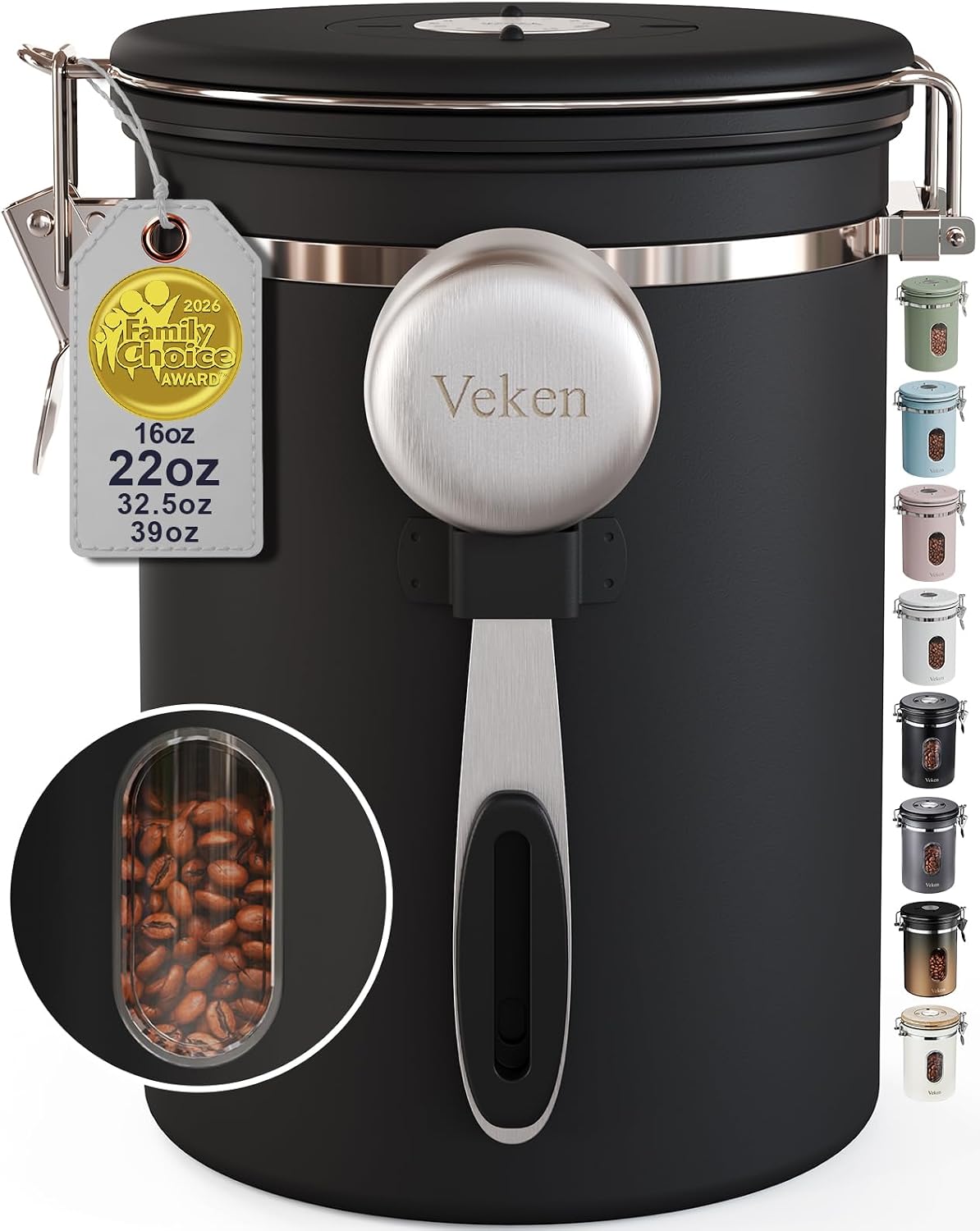
Coffee freshness is degraded by four environmental factors: oxygen, moisture, heat, and ultraviolet light. Storing beans in unsealed commercial paper bags with plastic clips accelerates staling.
- What Matters in Canister Design: An airtight silicone gasket, an opaque or UV-blocking body (such as 304 stainless steel), and a one-way CO2 degassing valve. Freshly roasted coffee naturally releases carbon dioxide for several weeks; a one-way valve allows internal gas to vent without permitting outside oxygen to enter. An integrated date tracker wheel helps record the roast or opening date.
- Practical Rule: Do not believe claims that canisters keep coffee "fresh indefinitely." Whole beans are best consumed within 3 to 5 weeks of their roast date regardless of storage.
Product Card: Veken 22oz Airtight Coffee Canister with Window
- Current Price: $31.99
- Rating: 4.8 out of 5 stars
- Review Count: 12,376
- Bought in Past Month: Amazon currently shows 3K+ bought in the past month
- Key Specs: 22oz capacity; food-grade 304 stainless steel construction; vertical acrylic viewing window; one-way CO2 exhaust valve; numerical calendar date tracker wheel on lid; includes dedicated stainless steel scoop.
- Best For: Countertop whole-bean storage with immediate visual inventory tracking.
- Why It Stands Out: The transparent vertical window allows you to check remaining bean levels without unsealing the silicone clasp, preventing unnecessary oxygen exposure.
- Potential Limitation: Because the acrylic window allows ambient light to enter, the canister should be positioned away from direct sunlight and stove heat sources.
- Marketplace: US (amazon.com)
- Amazon Search Link: Search Veken 22oz Coffee Canister on Amazon
Regional Model Comparison & Practical Barista Notes
- US & UK (Veken & Fentar Airtight Canisters): The 22oz (approx. 650g) volume holds a standard 12oz to 16oz (340g–450g) bag of specialty beans with ample headspace. The silicone sealing clasp provides tactile confirmation of airtight lockup.
- Germany & France (KC Kitchen & Co. 1kg Inox Canisters): German and French households that purchase standard 1kg whole bean packages benefit from larger 1000g capacity canisters, preserving bulk bean purchases without multiple storage vessels.
- Italy & Spain (Lavatelli & ACOMTUO Preservers): Specialized containers designed for moka grounds and fine espresso roasts, equipped with direct dosing dispensers or broad airtight silicone clamps.
Before adding it: Position airtight canisters away from direct sunlight and heat sources (such as oven sides or espresso machine boilers) to prevent interior condensation and bean oil degradation.
Shop this find:
- Check availability on Amazon US
- Check availability on Amazon DE
- Check availability on Amazon UK
- Check availability on Amazon FR
- Check availability on Amazon IT
- Check availability on Amazon ES
Coffee Bar Organizer
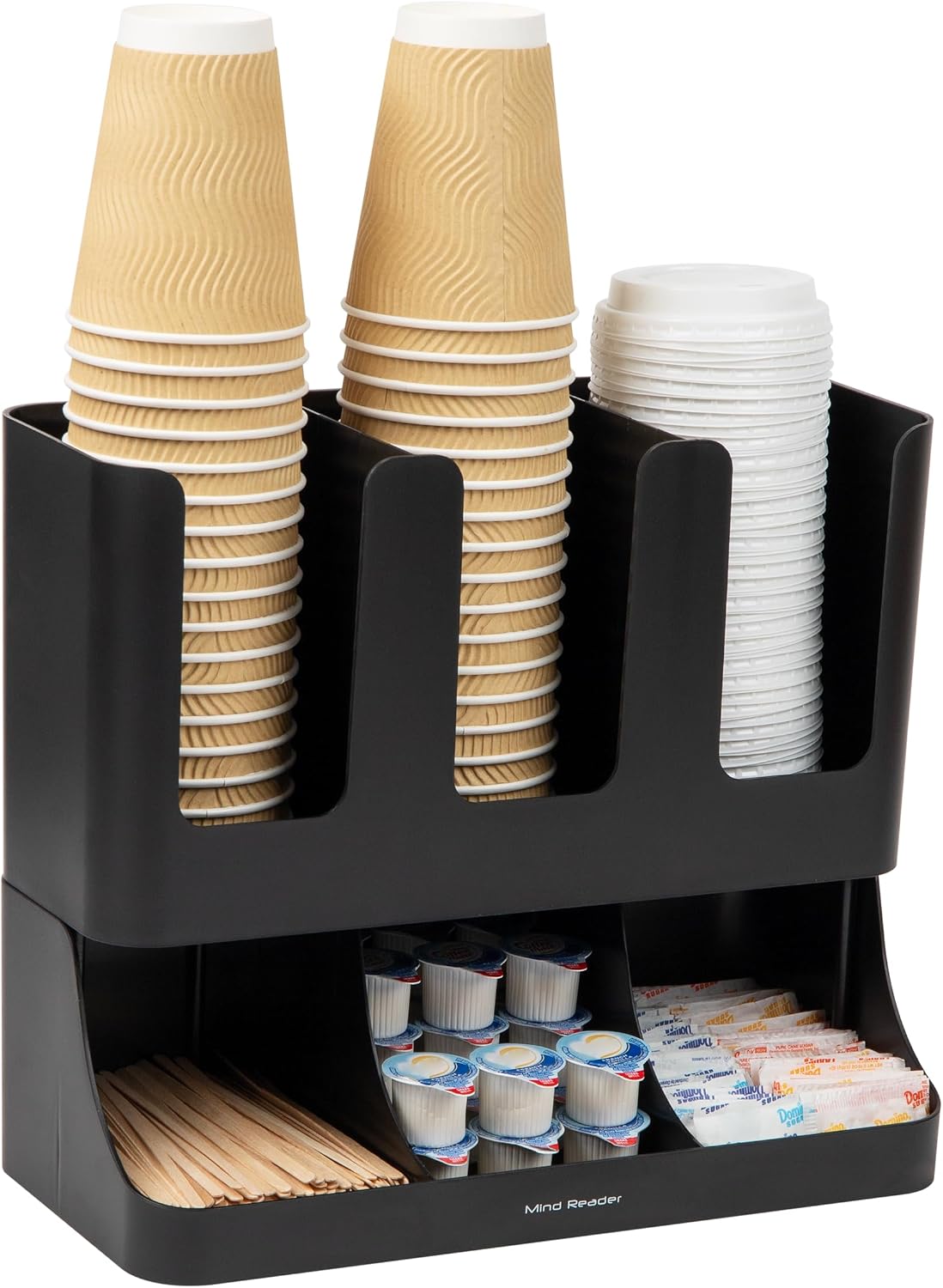
An organizer is justified only when you have multiple small items that otherwise scatter across prep counters. It is particularly valuable for multi-beverage stations combining espresso with capsules, tea bags, or sweeteners.
- The Space-Efficiency Rule: Choose an organizer based on the objects you actually need to store, rather than the number of compartments advertised. If your setup consists only of an espresso machine, a grinder, and a tamper, an organizer merely occupies counter space without solving a real storage need.
Product Card: Mind Reader 13-Inch Coffee Bar Organizer
- Current Price: $15.39
- Rating: 4.8 out of 5 stars
- Review Count: 9,276
- Bought in Past Month: Amazon currently shows 3K+ bought in the past month
- Key Specs: 13 × 6.4 × 11.5 inches (W × D × H); 6 divided storage compartments across tiered rows; durable lightweight plastic construction; textured wipe-clean surface.
- Best For: Organizing paper cups, lids, coffee pods, tea bags, stirrers, and small brewing accessories.
- Why It Stands Out: High vertical-to-horizontal ratio. At only 6.4 inches deep, it hugs backsplash walls closely while using its 11.5-inch vertical profile to store items upward.
- Potential Limitation: Its 11.5-inch height requires measuring overhead cabinet clearance; standard 18-inch clearance leaves ample room, but tight spaces may restrict access to the top compartments. Constructed of utility plastic rather than decorative wood or metal.
- Marketplace: US (amazon.com)
- Amazon Search Link: Search Mind Reader 13 Inch Coffee Bar Organizer on Amazon
Regional Model Comparison & Practical Barista Notes
- US & UK (Mind Reader & ANBOXIT Tiered Organizers): Ideal for consolidating mixed beverage stations that accommodate both whole bean espresso tools and single-serve pods or tea supplies.
- Germany, France & Italy (LEMIKKLE & VITVITI 2-Tier Stainless Shelves): European kitchens often favor dual-level bamboo or stainless steel shelving units that double as mug stands, allowing grinders or compact scales to slide neatly underneath.
- Spain (JUPPLIES Modular Storage Sets): Modular stacking organizers that can be arranged side-by-side or stacked vertically inside pantry cupboards for flexible kitchen dimensions.
Before adding it: Measure the vertical clearance between your countertop and the underside of your upper kitchen cabinets. Standard cabinets typically provide 18 inches of clearance; ensure the 11.5-inch organizer leaves enough room to lift mugs or accessories out of the top compartments.
Shop this find:
- Check availability on Amazon US
- Check availability on Amazon DE
- Check availability on Amazon UK
- Check availability on Amazon FR
- Check availability on Amazon IT
- Check availability on Amazon ES
Small Kitchen? Build Up, Not Out
In small apartments and galley kitchens with limited counter space, dedicating a wide, continuous surface to coffee is rarely practical. Expanding horizontally robs you of food prep space. The solution is adopting a vertical, tiered layout:
- Use Vertical Storage Racks: Instead of placing mugs and canisters in wide rows, employ two-tier wire shelves or tiered organizers that utilize the vertical clearance beneath overhead cabinets.
- Employ Countertop Trays with Discretion: A compact tray (e.g., 10 × 14 inches) can define the coffee zone visually and contain stray coffee grounds. However, ensure the tray does not waste perimeter space with thick, decorative rims.
- Wall-Mounted Accessories: Consider magnetic strips on the backsplash to store metal dosing funnels, portafilters, or milk pitchers off the counter surface entirely.
- Enforce the "Daily Use Only" Rule: Store descaling powders, backup filter packs, and novelty mugs in cabinets. Keep only what you touch before 9:00 AM on the counter surface.
What You Probably Don't Need on Day One
A frequent pitfall when building a home coffee bar is purchasing full multi-piece barista toolkits immediately. Introducing too many accessories on day one creates variable confusion and counter clutter.
Accessories should be evaluated according to their actual utility tier:
1. Essential for Most Workflows
- Digital Coffee Scale (0.1g): Necessary for dose consistency and brew ratio control.
- Dedicated Dosing Funnel: Necessary for containing ground coffee during transfer and distribution.
2. Useful Depending on Your Setup
- WDT Needle Distribution Tool: Useful for fine-tuning extraction on unpressurized baskets, but optional on day one.
- Calibrated Pressure Tamper: Helpful if you struggle with level tamping, but unnecessary if your standard tamper fits your basket properly.
- Dosing Cup: Useful if your grinder lacks a portafilter cradle or retains grounds, but redundant if you grind directly into a funneled portafilter.
- Puck Screen: Helpful for cleanliness, but not a substitute for proper puck preparation.
3. Nice-to-Have / Pure Organization
- Multi-Tier Condiment Organizers: Valuable for pod or tea drinkers; redundant for minimalist espresso owners.
- Decorative Wooden Trays & Tamping Stations: Aesthetically pleasing, but consume significant horizontal counter space.
WDT Discussion: When It Helps and When to Skip It
Weiss Distribution Technique (WDT) tools feature fine, flexible acupuncture needles (typically 0.3mm to 0.4mm in diameter) designed to stir and de-clump coffee grounds within the portafilter basket before tamping.
- When It Helps: WDT is genuinely useful if you use an unpressurized basket paired with a standalone espresso grinder that produces clumpy grounds. By breaking up internal dense pockets, it reduces water channeling and promotes more uniform extraction.
- When to Skip It: If you brew with pressurized (double-walled) baskets, pre-ground commercial coffee, French press, or pour-over, a WDT tool provides zero practical extraction benefit. Furthermore, if you are still learning the basics of bean freshness, grind size, and level tamping, adding needle distribution simply introduces another manual variable before mastering the fundamentals.
Puck Screen Discussion: Cleanliness vs. Extraction Hype
A puck screen is a thin, laser-etched mesh disc placed on top of the tamped coffee bed before locking the portafilter into the espresso machine.
- The Genuine Practical Benefit: Its most tangible, proven value is cleanliness. The screen acts as a physical barrier preventing coffee grounds from being sucked up into the shower screen and group head when the three-way solenoid valve releases pressure after extraction. This significantly reduces routine group head cleaning and backflushing maintenance.
- The Extraction Reality: While a screen can assist in softening initial water impact from aggressive group heads, it is not a magic extraction upgrade. It cannot fix an uneven grind, bad distribution, or channeling. If you purchase a puck screen, buy it for easier cleanup—not with the expectation of dramatically transforming espresso flavor.
A Simple Coffee Bar Setup for Different Budgets
You can assemble a highly functional coffee bar at various investment levels without overspending.
1. The Minimalist Setup (Under $50)
- Focus: Absolute workflow essentials with zero counter clutter.
- Components:
- Compact Digital Scale with Timer (e.g., Ataller Mini or budget precision scale: ~$11–$15)
- Dedicated Sized Dosing Funnel (matching 51mm, 54mm, or 58mm: ~$7–$18)
- Existing machine & tamper
- Total Footprint: Less than 1 square foot of counter space.
2. The Practical Home Setup ($75–$120)
- Focus: Clean workflow, bean preservation, and localized organization.
- Components:
- Micro-Footprint Precision Scale (e.g., Maestri House S2: ~$27)
- Twist-Lock Dosing Funnel (e.g., Breville 54mm: ~$18)
- Compact 12oz Frothing Pitcher (e.g., Adorever 12oz: ~$8.50)
- Airtight Canister with CO2 Valve (e.g., Veken 22oz: ~$32)
- Compact Countertop Knock Box (~$15–$20)
- Total Footprint: Approximately 18 to 24 linear inches of counter width.
3. The Full Espresso Workflow Setup ($150–$220+)
- Focus: Comprehensive puck preparation, vertical storage, and multi-beverage consolidation.
- Components:
- Micro-Footprint Precision Scale with Auto-Timer (~$27)
- Premium Dosing Funnel (~$18)
- 12oz Stainless Frothing Pitcher (~$8.50)
- 0.35mm Needle WDT Tool with Stand (e.g., NESSUS WDT: ~$12)
- Airtight Degassing Bean Canister (~$32)
- Countertop Knock Box (~$20)
- Vertical Multi-Compartment Organizer (e.g., Mind Reader 13": ~$15.50)
- Food-Grade Silicone Tamping Mat (~$10–$15)
- Total Footprint: Approximately 24 to 36 linear inches of dedicated counter space.
The Best Coffee Bar Is the One You Can Keep Organized
A successful coffee bar is measured by how effortlessly it functions at 6:30 AM when you are half-awake and pressed for time.
Keep the following core principles at the center of your station:
- Let workflow dictate layout: Position whole beans next to the grinder, the grinder next to the machine, and the knock box adjacent to the group head.
- Prioritize right-sized tools: Choose 4-inch micro scales and 12oz pitchers that fit within domestic machine dimensions rather than oversized commercial gear.
- Intercept mess at the source: A dosing funnel prevents coffee dusting before it ever touches your counter.
- Expand vertically in small kitchens: Use tiered organizers and wall-mounted storage to protect horizontal prep space.
By selecting tools that solve genuine workflow frictions and skipping non-essential gadgets, you build a coffee station that remains organized, functional, and deeply rewarding to use every morning.
Frequently Asked Questions
How do I set up a coffee station in a small kitchen?
Group your machine and grinder closely together, place a compact micro-scale directly on the espresso drip tray, and store accessories in a nearby top drawer or on vertical tiered organizers. Avoid wide decorative trays that consume usable cutting and food-preparation space.
What should every home coffee bar have?
At minimum, an effective setup requires a coffee brewer or espresso machine, a burr grinder, whole bean storage, an accurate digital scale with 0.1g resolution, and a dosing funnel to prevent ground coffee spills. All other accessories depend on your specific brew method and workflow preferences.
Do I need a coffee scale for espresso?
Yes. Measuring ground coffee doses and liquid espresso yield by weight provides repeatable brew ratios (such as 1:2 in 25–30 seconds). Measuring by sightlines or volume is inherently inaccurate due to natural variations in coffee bean density and crema volume.
Is a coffee bar organizer worth it?
An organizer is worth the counter footprint only if you have multiple small items—such as filters, pods, tea bags, stirrers, and funnels—that would otherwise sprawl across prep surfaces. If your setup consists solely of a machine, grinder, and tamper, an organizer merely occupies counter space without solving a real storage problem.
How do I keep coffee accessories organized?
Assign every daily-use tool a permanent home immediately adjacent to where it is used. Store primary tools on or beside the machine, place secondary tools in an adjacent drawer, and relegate backup supplies, descaling chemicals, and extra mugs to upper cabinets or pantry shelves.
What coffee accessories are actually useful?
The highest-utility accessories are those addressing active workflow frictions: a 0.1g digital scale with timer for consistency, a dosing funnel to eliminate ground coffee spills, and an airtight canister with a one-way CO2 valve for whole-bean freshness. Specialized tools like WDT stirrers and puck screens offer incremental benefits, but are secondary to baseline workflow essentials.